

Growing your e-commerce business? Our shipping platform gives you the carrier choice and automations you need to scale and deliver 5-star experiences, without having to be a logistics expert.
14-day free trial
Transparent shipping rates
Cancel anytime
Europe’s #1 shipping software
trusted by 30,000+ e-commerce businesses




“Since we started using tracking e-mails, there’s less pressure on customer service, but above all, it ensures a positive customer experience.”– ByNouck


“Since we started using Sendcloud, our entire order processing has improved.”– Founder, Jimmy Joy


“We used to create labels manually, even at night. With Sendcloud we’ve saved 1 FTE and can now focus on growing This Unique.”– Co‑Founder & COO, This Unique


“I was able to pack 3 times as many parcels as I could before.”– Founder of NKM


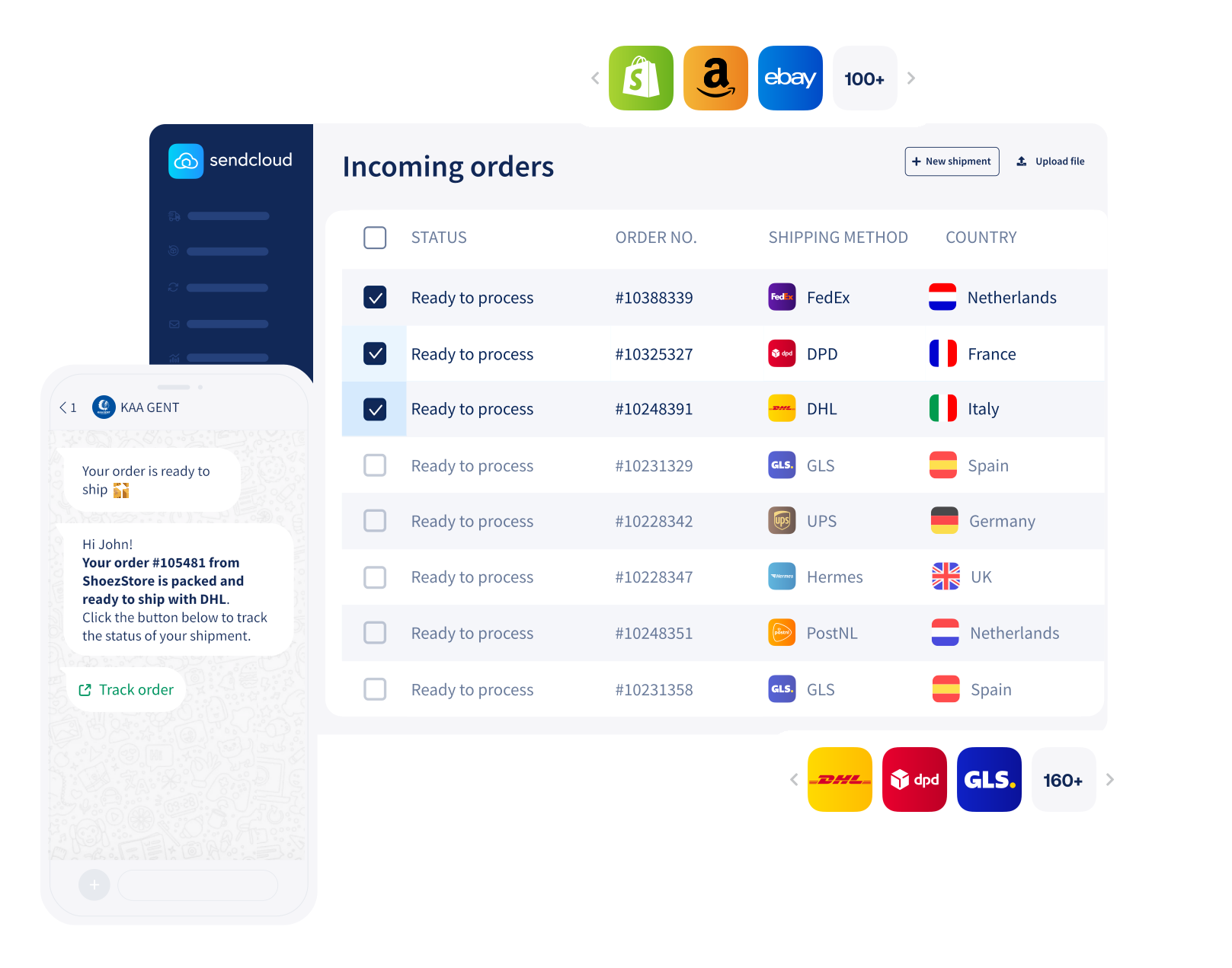
One platform to connect your shop, carriers, and customers
Ship with Europe’s leading carriers using our pre-negotiated rates or your own contract.








Winning e-commerce brands use shipping as their competitive advantage
Create shipping labels in seconds
Sendcloud users save an average of 7 minutes per parcel shipped.
Give customers a delivery experience they’ll love
Replace generic parcel tracking and returns with an experience that sets you apart.
Grow your business with shipping expertise
From shipping struggles to strategy wins, we’re here to help you grow your business.






Manage your shipping operations,
all from one place
From faster label printing to branded tracking and easy returns, automate the
shipping process you repeat every day, so you can focus on growing your business.


Plug in AI-powered shipping to your business
AI works in the background to suggest the best carriers, automate issue handling, and surface insights that help you cut costs and improve delivery performance.
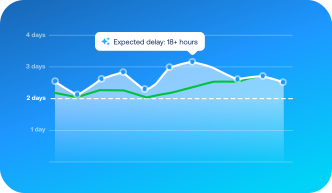
Smart shipping events
Get more events than carriers provide, from earlier alerts on delays to expiring pickups.
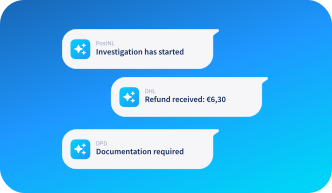
Claim handling through AI
We catch delivery issues early and handle the back-and-forth with carriers.

Smart carrier suggestions
Always get the best mix of cost, speed, and reliability for your shipments.
30K+
merchants ship smarter with Sendcloud.
99.99%
uptime, so you can ship without interruption.
9,500+
different shipping methods to reach customers everywhere.
390K+
service points, Europe’s largest network.
Hear how other successful merchants grew their business with Sendcloud
“
We’ve got our Trustpilot and CSAT scores up in 6 months . Moreover, insights into carrier performance allow us to negotiate better terms with the carriers.”

“
Over the last year, we have seen a 35% decrease in ‘Where is my order?’ questions, while 9 out of 10 customers say they appreciate proactive delivery communication.”

Ready to ship like the big brands?
Automate your shipping from checkout to returns and exceed customer expectations with a 5-star delivery experience.
FAQs
What is shipping software?
A shipping software is a tool designed for e-commerce businesses to simplify the parcel delivery process. It connects online stores to carriers and offers features like label printing, multi-carrier delivery options, parcel tracking, return handling, and more.
By having all these features in a single platform, a shipping software’s goal is to significantly reduce the time, effort, and cost of the parcel delivery process, making it an essential tool for e-commerce businesses.
Is shipping software a good fit for my business?
If you’re past the early hustle and ready to bring more structure to your shipping, maybe you’ve added a team member or just want things to run smoother, then Sendcloud is built to support your next stage of growth.
Do you spend a lot of time on:
- Finding the best carrier for every parcel?
- Copy-pasting addresses to create shipping labels?
- Picking and packing your orders?
- Creating international customs documents?
- Answering “where is my order” calls and emails?
- Processing returns manually?
- Endless back-and-forth with carriers to resolve claims?
- Resolving delivery issues only when customers complain?
Sendcloud helps you automate all of this, while giving you access to the right carriers, better rates, and branded tools that help you be as professional as the big brands, without needing a full logistics team.
How does Sendcloud’s shipping software work?
You can use Sendcloud’s shipping software through a user-friendly interface or via the API. Once you set up your account, Sendcloud automatically imports your order details.
This allows you to select a delivery option and create the shipping labels with a single click (in bulk or one by one).
After a parcel is picked up by the carrier or dropped off at a service point, Sendcloud provides real-time tracking updates, which you can automatically send to your customers to keep them informed.
If customers want to issue a return, Sendcloud allows them to do it via an automated portal, without any manual work from your side.
You can also set up a brand, add your logo to shipping labels, tracking emails, and return portal, and more—all to create a fully branded post-purchase experience.
Do I need a carrier contract to use Sendcloud?
You have the flexibility to either use your own carrier contract or Sendcloud’s shipping rates.
We offer pre-negotiated shipping rates with various carriers, allowing you to ship without needing your own carrier contract.
However, if you already have a carrier contract and are subscribed to one of our paid plans, you have the option to upload your existing contract to the Sendcloud platform.
Where can I find Sendcloud's shipping rates?
For a full overview of Sendcloud’s shipping rates, please create a free account.
Once in your Sendcloud account, go to Shipping > Shipping prices to view the available shipping or return methods per carrier and the corresponding prices.
You will be able to select the direction of your shipments (return or outbound), enter the dimensions and weight of your parcels, and choose the countries you are interested in. Easily sort and filter the results to choose the best shipping method based on price, transit time, popularity, customer rating, and more.
It is also possible to retrieve our shipping rates with the API.
Can I connect Sendcloud to my current e-commerce platform?
Sendcloud seamlessly integrates with over 100 shop systems, marketplaces, WMS, and ERPs, including popular platforms like Shopify, WooCommerce, Amazon, and eBay. Browse our App Store to see all of them.
Don’t worry if your system isn’t natively supported; you still have options. Sendcloud offers the flexibility to manually create shipments, upload orders via CSV files, or integrate your system through our API.
From which countries can I ship with Sendcloud?
Sendcloud fully supports shipping from 8 European nations: Austria, Belgium, France, Germany, Italy, the Netherlands, Spain, and the United Kingdom.
If you have an invoice address in any of the countries above (except for the UK) and a direct contract with a supported carrier, you can also ship from Czechia, Denmark, Poland, Portugal, and Sweden.
From any of these countries, you can ship to destinations worldwide.