


Online retail is entering a new phase, and the e-commerce trends for 2026 reflect a deeper structural shift across the industry from rapid expansion to operational maturity.
For years, success was measured in scale: more traffic, more markets, more orders. In 2026, competitive advantage is measured differently. It’s measured in predictability, transparency, efficiency, and trust.
AI is becoming infrastructure rather than innovation. Cross-border complexity is reshaping conversion strategies. The post-purchase experience is emerging as a competitive differentiator rather than a back-office function.
After years of scaling fast, businesses are under pressure to scale smart. That means tighter margins, stronger system integration, and full visibility across the entire commerce journey.
In short, e-commerce becomes less about hype and more about performance.
🎧 Busy packing orders? Just press play and listen to the blog instead!
What are the top e-commerce trends for 2026?
Based on insights from leading e-commerce experts across fields, here are the 7 shifts set to define the next era of online retail.
- Agentic commerce reshapes buying
- AI-native operations power infrastructure
- Cross-border transparency drives trust
- Profitability replaces growth-at-all-costs
- Post-purchase and exception handling define loyalty
- Delivery exceptions become moments of brand truth
- Out-of-home delivery becomes the new standard
1. Agentic commerce redefines buying
AI is no longer just assisting shoppers. It is starting to buy for them.
In 2026, we will see the rise of agent-led buying, where AI systems research, compare, negotiate, and complete purchases in seconds. For retailers, this changes the rules of competition.
Iryna Agieieva, Director of Product Management at Mollie, captures the shift:
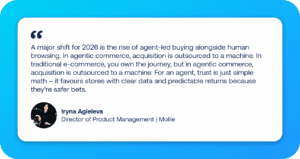
When a machine becomes the decision-maker, persuasion works differently.
For example, imagine an AI agent comparing two stores selling the same product in Germany and the Netherlands. Store A shows consistent 2-day delivery across both markets and clear return conditions. Store B displays variable delivery times and unclear cross-border fees. The agent will prioritize Store A, not because of branding, but because the risk profile is lower.
Stefan Hamann, co-CEO of Shopware, reinforces how structural this shift will be:
“Agentic Commerce and AI automation will shift purchasing from clicks to agents that research, negotiate, and buy within seconds […] AI will no longer be a differentiator, but a prerequisite for participating in digital commerce.”
And there’s a deeper consequence. When an agent completes the purchase, the first meaningful interaction with the actual customer often happens after payment.
“Your post-purchase experience – delivery, packaging, support – becomes your primary loyalty engine, and your chance to turn a cold, bot-led transaction into a warm, direct relationship,” highlights Iryna Agieieva.
AI agents don’t respond to brand storytelling the way humans do. They prioritize structured data, clear policies, predictable delivery windows, and low-risk returns. It favors stores with transparent pricing, reliable shipping, and consistent outcomes.
As Albert Morcillo, CTO at Rocket Digital, notes:
“It has never been easier or faster to adapt to emerging consumer trends, while also unlocking new advertising opportunities for brands ready to make the most of the technology. I believe consumers will be able to make better, faster purchasing decisions, while brands can build stronger loyalty through personalized, relevant content.”
2. AI-native operations become infrastructure
For years, the focus was on personalization, chatbots, and smarter ads. In 2026, AI moves deeper into the business. It shifts from front-end optimization to the operational backbone.
Pedro Albaladejo, CCO at Webimpacto, describes the broader transformation:

This isn’t about adding another tool to your stack. It’s about connecting the ones you already have.
AI is increasingly embedded across the operational layer: commerce platforms, marketplaces, warehouse management systems, shipping workflows, forecasting tools, and finance operations. Instead of asking, “How do we increase traffic?” retailers are asking, “How do we reduce friction across the entire order lifecycle?”
If your systems are disconnected, growth amplifies friction.
One concrete example of this shift is the evolution of ERP systems. Once primarily accounting tools, they are becoming coordination hubs that centralize operational data and automate workflows across departments.
Mergim Thaqi, Senior Product Manager at Weclapp, puts it clearly:
“The key will be to systematically automate workflows and centralize data from online stores, marketplaces, and financial systems. AI-powered tools and cloud-based ERP systems will become the strategic backbone for efficient, scalable growth”.
But ERP is only powerful when it is connected to marketplaces, fulfillment operations, carrier performance data, and financial reporting.
As order volumes rise, so do shipping volumes, returns, and financial reconciliation tasks. Without centralized coordination, each new order adds operational strain instead of efficiency.
Scale without coordination creates instability. End-to-end integration across commerce, fulfillment, and finance is becoming the real competitive edge.
3. Cross-border trust becomes a conversion driver
European retailers operate in a market that is geographically connected but operationally fragmented, especially when it comes to international shipping. Different VAT rules. Different duties. Different return expectations. Different carrier networks.
For years, this complexity was treated as a backend challenge. In 2026, it becomes a conversion factor.
Fernando Pedraz, Co-Founder & CEO of Reveni, highlights the hidden challenge:

But what matters most is how that complexity is experienced by the customer.
Imagine two similar webshops selling in Belgium. Store A clearly displays duties and taxes at checkout, guarantees a realistic 3–5 day delivery window, and offers prepaid international returns. Store B shows only the product price, with vague delivery estimates and no clear return conditions.
An international customer comparing the two will choose the option that feels safer, not necessarily the cheaper one.
Bob Rockland, co-founder of Code, reinforces the link explicitly:
“In 2026, tariffs will not just shape the cost of cross-border sales, but define the gap between visibility and growth. Brands that strategically integrate tariffs into their pricing and value proposition will build trust, accelerate conversions, and turn borders into a scalable marketing channel.”
When pricing includes transparent duties, customers feel safer. When returns across borders are predictable, conversion improves. When delivery times are realistic, trust grows.
4. From growth-at-all-costs to disciplined expansion
For years, scale was the primary success metric. More traffic. More markets. More orders. But in 2026, growth without visibility is a liability.
Carlos Liébana, CEO and founder of Factor Libre, describes the shift clearly:

The conversation is changing. Retailers are no longer asking how fast they can grow. They’re asking how cleanly they can scale.
Every new sales channel adds operational complexity. Every new marketplace adds integration pressure. Every new country adds cost variables.
In 2026, leaders are questioning every growth lever:
- Does this channel improve margin?
- Does this market increase operational risk?
- Does this carrier mix protect profitability?
- Does this campaign generate long-term or short-term volume?
Ben Hamilton, CEO of Base.com France, highlights the structural weakness many merchants still face:
“E-commerce still suffers from a deep ‘digital divide’: the further you move from the end customer, the weaker the level of digitisation becomes. For fast-growing merchants, this disconnect is the real scalability constraint. Without real-time inventory visibility and end-to-end system integration, growth doesn’t just add volume — it amplifies operational friction and risk.”
Front-end channels are often optimized and data-rich. But warehouses, suppliers, and upstream stock systems remain fragmented. That disconnect hides margin leakage.
The same discipline is reshaping investment decisions inside the warehouse. As Thomas Kircheis, founder of Pulpo WMS, observes:
“For ecommerce warehouses doing 1000+ orders daily, this isn’t automation for automation’s sake — it’s surgical efficiency and measurable savings.”
You might be growing revenue while quietly losing profitability through stock inaccuracies, inefficient carrier allocation, and hidden shipping overcharges.
For instance, choosing the cheapest carrier for every order might save €0.40 per shipment. But if that carrier generates 6% more delivery issues, the added support workload and refunds can easily erase the savings.
In 2026, operational visibility becomes non-negotiable.
5. Post-purchase becomes the loyalty engine
As commerce becomes more automated, human experience becomes more valuable.
Niels Bergmans, Head of Revenue at Returnless, puts it clearly:

This is the paradox of 2026: The buying journey may start with an algorithm, but loyalty is still built with people.
In agentic commerce, the first meaningful interaction with the human customer often happens after payment. Delivery updates. Packaging. Returns. Support. These are no longer operational afterthoughts. They are brand-defining moments.
And customers expect continuity.
They expect:
- Their return flow should feel as smooth as the purchase.
- Support teams need to know what happened online.
- Their in-store and online experience should make them feel connected.
- Tracking updates to be clear and proactive.
When post-purchase flows are fragmented, trust erodes quickly. Delayed refunds. Unclear tracking. Confusing return policies. Each friction point weakens loyalty.
But when delivery is predictable, communication is transparent, and returns are easy, something powerful happens: trust compounds.
As Mollie highlighted earlier, the post-purchase experience becomes your primary loyalty engine. It is your opportunity to turn a transactional moment into a relationship.
6. Delivery exceptions become moments of brand truth
No retailer wants delivery issues. Carrier delays, missed scans, lost parcels, and cross-border holds happen, and customers feel them immediately.
Anna Rouleau, Delivery Issue Expert at Sendcloud, sums up what’s at stake:

When something goes wrong, customers don’t just judge the carrier but the brand. And in an environment shaped by higher expectations and automated purchasing journeys, trust is fragile: if customers have to chase updates or repeat themselves to support, confidence drops fast.
But disruptions can also create loyalty if you handle them well.
A delayed parcel that is proactively communicated, refunded within 24 hours, and followed up with a clear explanation feels very different from a delay the customer has to chase through three support emails.
That’s also why more retailers are shifting from reactive support to proactive exception management. Instead of juggling inboxes, carrier portals, and manual claim processes, they centralize carrier communication, automate claim processing, and monitor delayed or exception shipments from a single workflow.
7. Out-of-home delivery becomes the new standard
Across Europe, out-of-home delivery is becoming a standard part of the e-commerce experience. Service points, parcel lockers, and in-store pickup are increasingly embedded in how consumers expect to receive their orders.
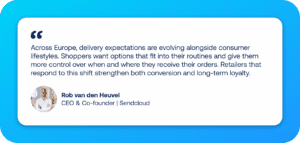
Our data from E-commerce Delivery Compass 2025, reinforces this transformation: 58% of European consumers now choose out-of-home delivery options as their preferred delivery method, making it the second most selected option after home delivery (75%).
That number reflects a deeper behavioral shift. Delivery choices are increasingly shaped by daily routines, mobility patterns, and urban living. Hybrid work, time spent outside the home, and changing schedules mean that waiting for a parcel at home is no longer the most convenient option.
Offering lockers and service points doesn’t just reduce missed deliveries; it also improves customer satisfaction. It increases predictability, lowers operational friction, and strengthens customer confidence. When shoppers can choose where and when to collect their parcel, hesitation at checkout decreases.
Taken together, these shifts demand a reset in how retailers operate.
Turning e-commerce trends 2026 into action
The e-commerce trends 2026 all point in the same direction: build operational control, real-time visibility, and delivery reliability into the core of your strategy.
Here’s where to focus.
1. Audit your operational reliability. If AI agents begin influencing purchasing decisions, inconsistent delivery times and unclear return policies will hurt visibility. Make reliability measurable and consistent.
2. Prioritize integration over expansion. Growth amplifies complexity. Ensure your shop, marketplaces, ERP, finance, and shipping systems share real-time data before expanding further.
3. Turn cross-border into a trust advantage. Make duties and taxes transparent. Simplify international returns. Treat compliance as part of your value proposition, not just a legal requirement.
4. Protect margin at every step of the order journey. Track true cost per order. Monitor carrier performance. Identify hidden inefficiencies in fulfillment and returns.
5. Redesign post-purchase intentionally. Delivery, tracking, returns, and support are no longer operational follow-ups. They are loyalty drivers. Make them branded, proactive, and connected.
Conclusion: performance over hype
The market is no longer rewarding growth alone. It is rewarding operational maturity.
Across every trend in 2026, the same forces define competitive advantage:
- Predictability, because AI agents reward consistency.
- Transparency, because cross-border expansion rewards clarity.
- Efficiency, because margin pressure rewards discipline.
- Trust, because customers reward brands that deliver reliably.
This is what performance over hype looks like. Where are you losing visibility, consistency, or reliability today, and how will you fix it before your competitors do?