


TL;DR: Cart abandonment in 2026 is largely influenced by delivery friction at checkout. Offering a small, localized set of delivery options, covering price, speed, and pick-up flexibility, helps shoppers find a fit and complete their purchase. Flexible delivery isn’t a nice-to-have anymore
It’s painful but true that cart abandonment is still incredibly high in 2026. According to Baymard Institute the average cart abandonment rate is 70.22%. This means most baskets never convert, even after shoppers have shown clear intent. We’ve collected expert insights and data to help you improve conversion rates through a better delivery strategy.
What really causes cart abandonment at checkout in 2026
Shoppers rarely abandon their carts because they lose interest. Often, friction appears right at the end of the journey. When shoppers reach checkout, expectations around delivery, cost, and convenience are already set.
Unexpected shipping fees, limited delivery options, or unclear timelines often trigger hesitation. While some abandonment is inevitable, a significant share happens at the exact moment shoppers are asked to make a delivery choice. That makes checkout one of the most decisive points in the entire customer journey.
In many cases, friction is caused by how your checkout is designed. Online retailers often optimize delivery setups for operational simplicity, limiting carrier choice or delivery methods to keep processes manageable behind the scenes.
That convenience, however, comes at the expense of conversion. The good news is that addressing shopper expectations at checkout doesn’t have to add operational complexity. Let’s first look at what shoppers actually care about, and how they make delivery decisions.
The importance of delivery for checkout conversion
At the checkout, shoppers weigh trade-offs in seconds. If you’re only offering one carrier and one shipping method, you’re presenting a single trade-off. That trade-off will never fit everyone considering a purchase. This is why single-option checkouts create silent drop-off.
To avoid this silent drop-off, it helps to understand what shoppers actually evaluate when choosing delivery at checkout.
What shoppers actually compare at checkout when it comes to delivery
When shoppers reach the delivery step at checkout, they’re looking for a few answers to their questions. How much will this cost me? When and where can it be delivered? And how much control do I have if something changes? In those few seconds, delivery options are compared side by side.
In practice, shoppers compare five key components:
Carrier choice, such as choosing a national carrier versus an international one like DHL, DPD or UPS
The delivery method, including home delivery, pick-up points, or parcel lockers
Speed options, from standard delivery to express options
Delivery costs and pricing options, offering all delivery options for free, all paid or offering a free shipping threshold
Rules, such as cut-off times and parcel types (in The Netherlands, letterbox parcels are very convenient as there’s a 100% first-time delivery success)
The more clearly those trade-offs are communicated, the easier it becomes for shoppers to recognize an option that fits their situation and complete the purchase. Does that mean you have to offer endless delivery choices? Not necessarily. We’ll look into a high-converting delivery setup next.
What a high-converting delivery setup looks like in 2026
A high-converting checkout balances customer choice with operational reality. It offers enough flexibility to cover different shopper needs, without overwhelming them or your teams behind the scenes.
How many delivery options should you offer?
More options do not automatically lead to higher conversion. Too many choices can even slow shoppers down. Most high-performing checkouts offer 3-4 delivery options per country. This typically includes a free or low-cost standard option, a faster or more specific paid option, and at least one out-of-home alternative.
Should you add out-of-home (OOH) delivery options?
For many shoppers, especially in Europe, pickup points and parcel lockers offer more control than home delivery. According to DHL research, 35% of Europeans and 25% of global shoppers have their items delivered directly to an out-of-home location.
Out-of-home delivery removes the need to be at home, reduces missed deliveries, and fits better around daily routines. What’s often overlooked is that OOH delivery is usually cheaper to offer as well. It gives shoppers a low-cost, low-friction alternative.
How to price and position delivery options?
Delivery costs are painful for both your bottom line and your shoppers. In fact, 66.3% of consumers say they’d abandon their carts due to (unexpected) high delivery costs. Inflation has amplified that effect. 70% of shoppers say they’ve become more price-sensitive, which impacts how they view delivery costs.
Another important factor is the psychological effect of free delivery. 82% of shoppers prefer free shipping over faster or customized options, and 70.5% are willing to add extra items to reach a free shipping threshold. Setting a smart minimum order value for free delivery can therefore increase the average order value while reducing checkout friction.
The key is to make trade-offs explicit. Clearly show price, delivery time, and service level differences. Customers who prefer speed or a specific time frame, such as evening delivery, are willing to pay for it. Others will deliberately choose a slower, lower-cost option instead.
Without a clear view of what shoppers actually prefer, improving checkout conversion becomes guesswork. Let’s take a closer look at how delivery preferences differ across European markets.
International differences in checkout delivery preferences
Delivery expectations vary by market, which makes a one-size-fits-all checkout a conversion risk. A few clear patterns stand out today:
Out-of-home adoption is driven by convenience: Shoppers choose pickup points and parcel lockers primarily to avoid waiting at home. Consumers in Italy, Spain, and France show the strongest preference for out-of-home delivery options, but parcel lockers are popular in the Netherlands too.
Speed expectations differ by market: Some countries show a stronger preference for next-day delivery. This shipping method specifically stands out in the UK (38.9%) and Germany (25.7%). And when asked how long shoppers are willing to wait for their delivery, Germany (43.7%) and Spain (44.6%) stand out and say they are willing to wait a maximum of 2–3 days for their parcel to arrive.
Cut-off times influence perceived convenience: Shoppers in the UK, Spain, and the Netherlands expect more flexibility when it comes to cut-off times, with many still expecting to order as late as 8 pm and receive their parcel the next day. In contrast, markets like Germany and Italy tend to expect cut-offs at noon, which clearly shows the difference of how shoppers evaluate whether a delivery option truly qualifies as “fast.”
Poor delivery experiences have a long-term impact: Delivery-related issues account for a significant share of checkout drop-off across Europe. In markets such as the UK and France, concerns around the delivery experience weigh especially heavily and also reduce repeat purchases. Find out more about how you can reduce delivery delays here.
Unexpected delivery costs are a major abandonment trigger: Unexpectedly high shipping fees are one of the most common reasons shoppers abandon checkout. Within Europe, frustration around delivery costs shows up most strongly in markets like Germany and the UK.
Want more insights? Discover our E-Commerce Delivery Compass that shows what 8,000+ consumers in Europe value in delivery.
As you can see, there’s a lot to take into account to optimize the checkout experience. This doesn’t mean it has to be difficult to operationalize it. Here’s how you can design a high-conversion checkout focused on flexible delivery.
Designing a high-conversion checkout with flexible delivery options
The first step to design a checkout that converts is by starting to treat delivery as part of a buying decision. Your goal isn’t to offer every possible delivery option, but you should be able to present a small set of relevant choices that reflect how your target audience actually decides.
That means combining the right carriers, delivery methods, prices, and cut-off rules into a clear setup. Shoppers should be able to understand the differences between options at a glance and quickly recognize which one they prefer.
At the same time, those options need to be feasible for your operations too. What you show at checkout must align with carrier performance, warehouse capabilities, and support processes behind the scenes.
Here’s how that works in practice:
Offer 3-4 delivery options per market that cover the most common trade-offs such as low cost, speed and pick-up flexibility.
Make trade-offs explicit by clearly communicating price, delivery time (and cut-off time for next-day delivery), and service level differences when you add a premium option, so shoppers understand what they are choosing and why options are priced differently.
Localize delivery rules by market by adjusting cut-off times, delivery methods, carriers and default options to match local expectations.
Ensure carrier availability, warehouse processes, and cut-off times support what’s shown at checkout to avoid failed or delayed deliveries. A dynamic checkout setup allows you to align your front-end with your back-end operations and make quick changes when needed. With shipping rules, you can automatically adjust delivery methods, carriers, and service levels based on real-time back-end data such as destination country, order value, weight, or checkout method.
Monitor conversion rates, what delivery methods are picked most, and delivery issues to continuously optimize carrier choices and delivery methods. Smart shipping data will allow you to keep track of carrier performance and make the best choice for your e-commerce business.
How to improve the checkout experience with limited resources
When you’re growing your store and don’t ship thousands of parcels a month yet, it can be challenging to offer multiple delivery methods. You might not have multiple carrier options, international customers, or advanced automation in place. That’s not a barrier to improving checkout conversion.
Even with limited resources, you can create meaningful choice by offering at least one standard and one out-of-home method. This way you can make the out-of-home method slightly cheaper and offer flexibility. With Sendcloud’s checkout feature you can easily enable the shipping options you’d like to offer in your checkout.
Small structural improvements can already reduce hesitation at checkout. Looking at improving checkout conversion rates beyond delivery? Here are 8 practical tips you can apply to improve your checkout rates.
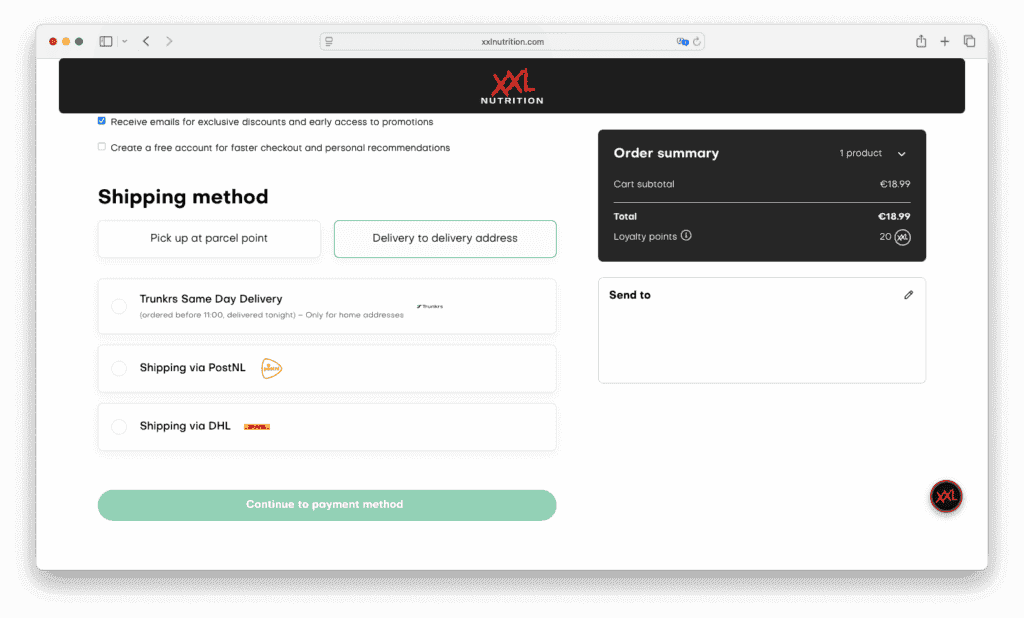
XXL Nutrition shows how delivery choice can be presented without adding complexity. Shoppers can choose between pick-up point delivery and home delivery, select their preferred carrier including a same-day delivery option, and see service differences at a glance. The layout is clean and focused.
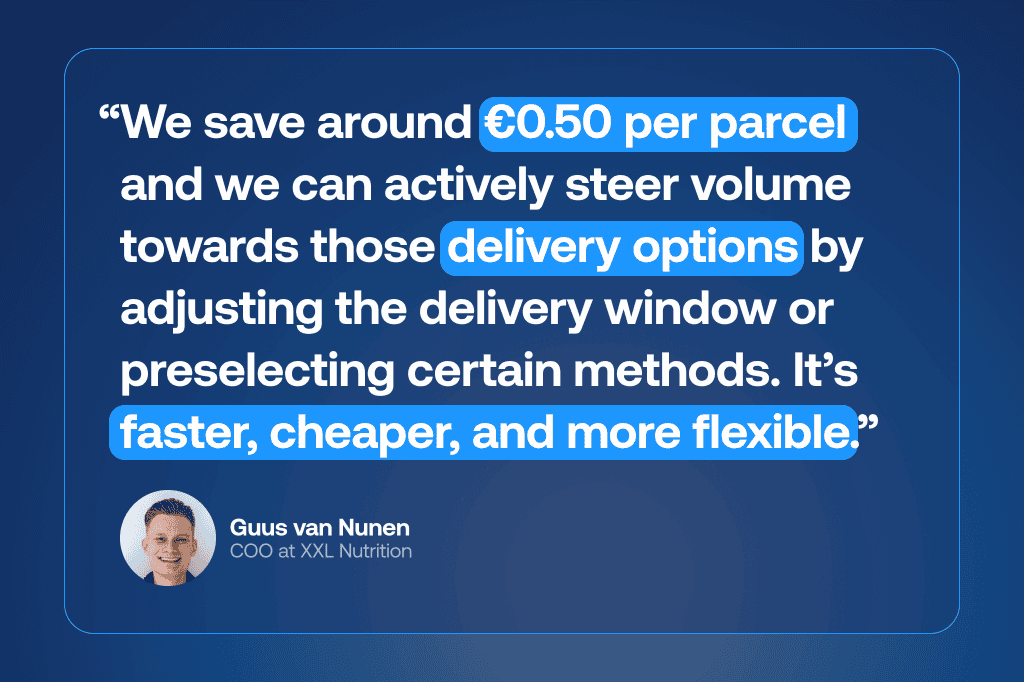
Find out more about how XXL Nutrition optimizes shipping methods at checkout. Still not sure about the impact of delivery and if going the extra mile will pay off? Need internal proof? Here’s what you can expect when optimizing delivery at checkout.
The business impact of flexible delivery methods
Flexible delivery methods have a direct impact on both revenue and efficiency. We often see that online retailers who move from a single-carrier setup to a multi-carrier strategy reach a conversion increase by 2-4 percentage points.
This means you can easily increase sales without investing in attracting new customers. At the same time, delivery choice reduces pressure on your processes. When customers consciously select a cheaper, slower option or pay for a faster one, expectations are set upfront. This leads to fewer WISMO questions.
A multi-carrier setup also reduces dependency risk. If your primary carrier runs into disruption, such as strikes, network congestion, or missed pickups, you risk delays and getting frustrated customers. With a multi-carrier setup, you can start shipping with a backup carrier in days, so orders keep moving and your mailbox won’t be flooded with questions and complaints.
Rather than optimizing for your own convenience, flexible delivery shifts the focus to total business impact across conversion, costs, and customer experience.
Make delivery the reason your customers are coming back
The main question you should ask yourself right now is, what are you waiting for? The difference between a completed purchase and a silent drop-off often comes down to whether shoppers can choose a delivery option that fits their expectations.
And with Sendcloud, you can activate and manage delivery options without the hassle. From shipping options that are preferred by your customers, to carrier selection, and cut-off rules, everything can be optimized centrally. What shoppers see at checkout is directly connected to what your carrier, warehouse(s), and support team can deliver in practice.
And the checkout is just the beginning of the full delivery journey. Sendcloud gives you access to 170+ (inter)national carriers, delivery performance insights, and automated issue and claims handling. Give your teams control over shipping without adding operational complexity.
The result is fewer failed deliveries, lower support pressure, and a delivery experience that supports growth instead of holding it back. Want to increase conversion, then we’re here to give you the foundation to win the hearts of online shoppers.
Discover more on our how it works page, learn how you can start for free or request a demo when you’re looking for a solution that can help you scale across carriers, markets and teams.


Author and researcher
As Global Content Manager at Sendcloud, Johanna leads content strategy across e-commerce, logistics, and shipping automation. With a background in B2B SaaS and a passion for clear communication, she creates educational resources that help over 30,000 online stores optimize and scale their shipping operations.

Subject matter expert
Huib Adriaans is the VP of Enterprise at Sendcloud and the founder of Tracey. With 10+ years in the logistics space, he leverages shipping intelligence and data-driven insights to help merchants reduce "Where is my parcel?" enquiries and build world-class delivery experiences.
How much time can you save on shipping?

Share
Recommended For You
Enterprise
Tracking
Sendcloud’s Post-Purchase Solution, now available in the tools your team already uses
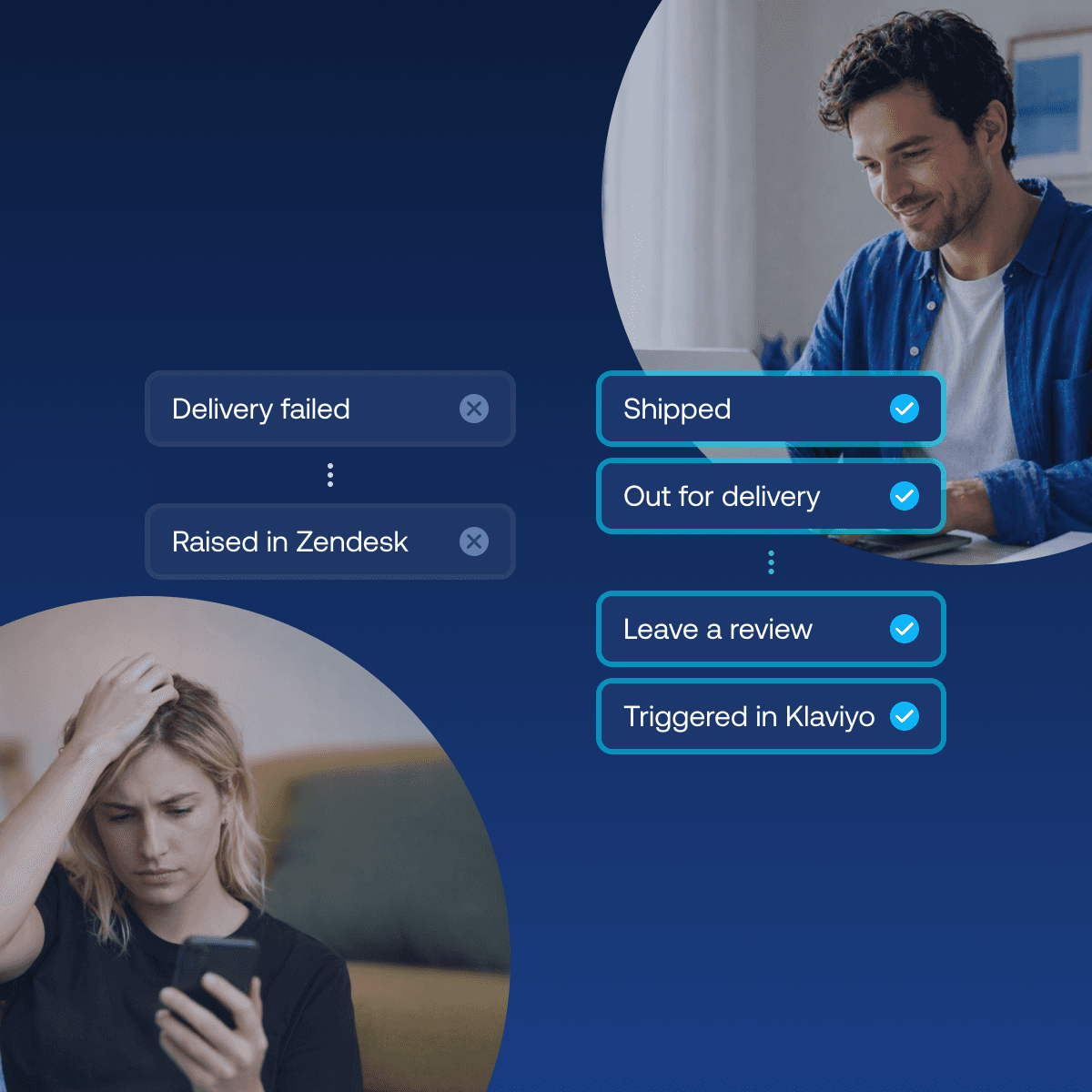
Most retailers leave post-purchase on default, letting courier notifications and out-of-the-box tracking emails speak for the brand. Sendcloud's Post-Purchase Solution changes that: delivery events now flow straight into the tools your team already uses, like Gorgias, Zendesk, Freshdesk and Klaviyo, turning tracking updates into branded touchpoints, proactive support alerts, and automated claims, no matter which courier or platform you ship with.

Shipping
Integrations
Best Shopify shipping apps: compare features, pricing & automation
Compare the best Shopify shipping apps for automation, couriers, labels, tracking, returns and international shipping. Find the right app for your store.

Shipping Intelligence
Shipping
E-commerce