Over the Past Three Months, Nearly One in Two European Consumers Have Abandoned an Online Purchase Because of Delivery


Last updated:
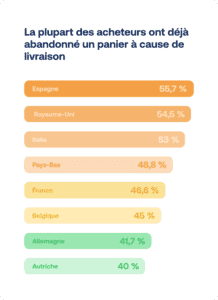
A new study conducted by Sendcloud across eight European markets reveals why 48% of consumers have abandoned a purchase for delivery-related reasons at checkout, and why 42% of them hold the retailer responsible when something goes wrong.
Paris, May 27, 2026 — Delivery has become one of the biggest obstacles to conversion in e-commerce. According to a new study by Sendcloud, Europe's leading e-commerce delivery platform, nearly half of European consumers (48%) abandoned an online purchase in the past three months because of delivery-related issues at checkout. Unexpected delivery costs, delivery times perceived as too long, and a limited choice of delivery options were the main reasons behind these abandonments. In France, this figure stands at 47%, very close to the European average.
The new E-commerce Overview, based on responses from 8,000 online shoppers across 8 European markets, also found that 77% of them (a figure also observed in France) had experienced at least one problem with their last delivery. And when delivery doesn't go as planned, 42% of shoppers hold the retailer responsible, not the carrier. This figure rises to 47% in France.
Delivery penalizes retailers twice: once before the purchase, and again after the order has shipped. At checkout, unclear costs and a limited choice of delivery options drive shoppers away. After the purchase, poor communication about delivery issues damages customer trust and loyalty.
Overall, these findings show that delivery issues are no longer just occasional inconveniences. They have a direct impact on conversion rate, customer retention, and brand reputation.
Before the purchase: delivery issues drive shoppers away
Retailers often attribute cart abandonment to rising delivery costs or carrier performance. But the research highlights another issue: the delivery experience itself. According to the report, the main reasons European consumers abandon their cart at checkout are:
unexpected delivery costs appearing at the end of the checkout process (40.7% in Europe, 39% in France);
delivery times perceived as longer than expected (27.1% on average in Europe — rising to 31% in France);
the absence of a convenient pickup point (13.6% in Europe, 14% in France).
The main source of frustration is not delivery itself, but how delivery options are presented. Costs appear too late, delivery times are unclear, and shoppers often don't have enough choice.
Results also vary considerably from one market to another. In France, 47% of consumers have abandoned a purchase because of delivery times — and impatience with these delivery times is the leading cause of abandonment, more so than in any other European market.
After the purchase: when delivery goes wrong, retailers pay the price
The cost of cart abandonment is only part of the problem. The report also highlights a growing accountability gap between sellers and carriers.
When a delivery problem occurs, 42% of European consumers hold the seller responsible, not the carrier. Even when sellers outsource their delivery operations, customers continue to see delivery as an integral part of the brand experience.
Improving the customer experience before and after the purchase
This study highlights a clear opportunity for retailers. Brands that improve delivery-related communication and offer more flexibility at checkout are more likely to reduce abandonment rates and build customer loyalty.
According to Sendcloud's data, 72% of French consumers — the highest rate in Europe — are more likely to complete a purchase when several delivery options are offered, compared to 50% on average in Europe.
After the purchase, communication matters more than speed. More than 9 in 10 French shoppers (92%) find proactive information about delivery delays helpful, while 83% say they are more loyal to retailers who communicate clearly when something goes wrong.
« Most retailers still see delivery as a logistics problem. Yet the data tells a different story: when something goes wrong, shoppers blame the retailer, not the carrier. The answer isn't to deliver faster, but to offer clearer pricing, more choice at checkout, and honest communication when a delivery doesn't go as planned », says Rob van den Heuvel, CEO and co-founder of Sendcloud.

To discover all the study's findings, download the full « E-commerce Overview » report.
About Sendcloud
Sendcloud is Europe's leading shipping platform, helping e-commerce businesses streamline their logistics and deliver a great customer experience.
Our suite of connected tools centralizes and automates the entire shipping process: label creation, parcel tracking, returns and claims management, and more. We help brands, marketplaces, and logistics companies meet growing customer expectations.
Founded in 2012 with the ambition to give e-commerce businesses the power to compete with the biggest players, Sendcloud is backed by Softbank and trusted by more than 30,000 brands across Europe.


Author and researcher
Marina Fernández leads the Communications craft, creating e-commerce, B2B, and SaaS content. She ensures that every piece of content is of the highest quality and effectively meets its intended purpose.
How much time can you save on shipping?

Share
Recommended for you

Over the Past Three Months, Nearly One in Two European Consumers Have Abandoned an Online Purchase Because of Delivery
48% of European consumers abandon online purchases because of delivery: unexpected costs, long delivery times, and lack of choice.

Consumer trends in e-commerce 2026: What European shoppers really want
We surveyed 8,000 European shoppers to map the biggest consumer trends in e-commerce, from checkout to post-purchase, loyalty, and returns.
E-commerce monitor 2026: The era of automatic growth seems over
The E-commerce Monitor 2026 shows webshops focusing less on fast growth and more on profitability, customer retention, and efficiency. Discover the key trends.