


![Nieuwe productkansen ontdekken [5 slimme manieren van een expert]](https://framerusercontent.com/images/f64hmTF6Kt4KCL4WBAbxN50oZQ.jpg?width=1240&height=805)
The success of your webshop depends on a lot of factors. One of the most important, of course, is your product range.
And finding a solid product offering happens to be one of the biggest challenges in e-commerce logistics.
Want to start a webshop, or expand your current range? And do you want to know how to make the best choices along the way?
In this article, you'll learn how easy it is to discover new product opportunities with the 5 essential methods we cover.
That way, you'll keep your product range relevant and up to date!
Discover new product opportunities (5 smart methods)
To discover new product opportunities, you could hire a consulting firm or buy expensive tools these days.
But a bit of online research can get you surprisingly far, without spending a cent.
Sites like Reddit, social media channels, and marketplaces make it easy to find out what's on people's minds.
On Reddit, for example, you can search for 'product trends' or 'products to sell'. Looking at which topics are popular can also give you product ideas.
Prefer to keep your search closer to home? Productnieuws.nl covers new products in the Dutch market.
1. Take cues from influencers
When it comes to social media, keep an eye on influencer accounts. They tend to jump on trends early.
Influencers also have a large following, and with a bit of luck, their followers will want those products too.
Which influencers can help spark product ideas depends heavily on the niche you operate in.
A quick search for 'popular influencers' combined with your niche will quickly turn up interesting results.
There are also countless marketing agencies that work with influencers these days, such as Linkpizza, Juulr, Join, and Hulc.
If you dig into the influencers connected to these agencies, chances are you'll find a few good matches.
Before you stock up on the recommended products, though, consider whether the item is too trend-sensitive. Short-lived hypes only carry you so far.
But if you catch a new trend at the right moment, it can bring in solid revenue for a long time.

2. Scour online marketplaces
More and more retailers sell their products through platforms like Marktplaats, Amazon, or Bol.com.
Thanks to this huge selection and consumers' preference for convenience, more and more people start their online search on these marketplaces.
If you have a product idea, it's worth checking whether similar items are already being sold on these kinds of platforms.
If they are, and the product is still trending, you know there's at least enough demand for it. That's worth exploring!
If the selection on these platforms is already large, and prices are competitive too, you probably won't get rich through these channels.
But there are plenty of other channels to sell your products through. Besides your own webshop, social media, pop-up stores, and market stalls can all be good sources of income.
If an item isn't selling much yet but you spot strong demand for it, that's the moment to start offering it on these different platforms.
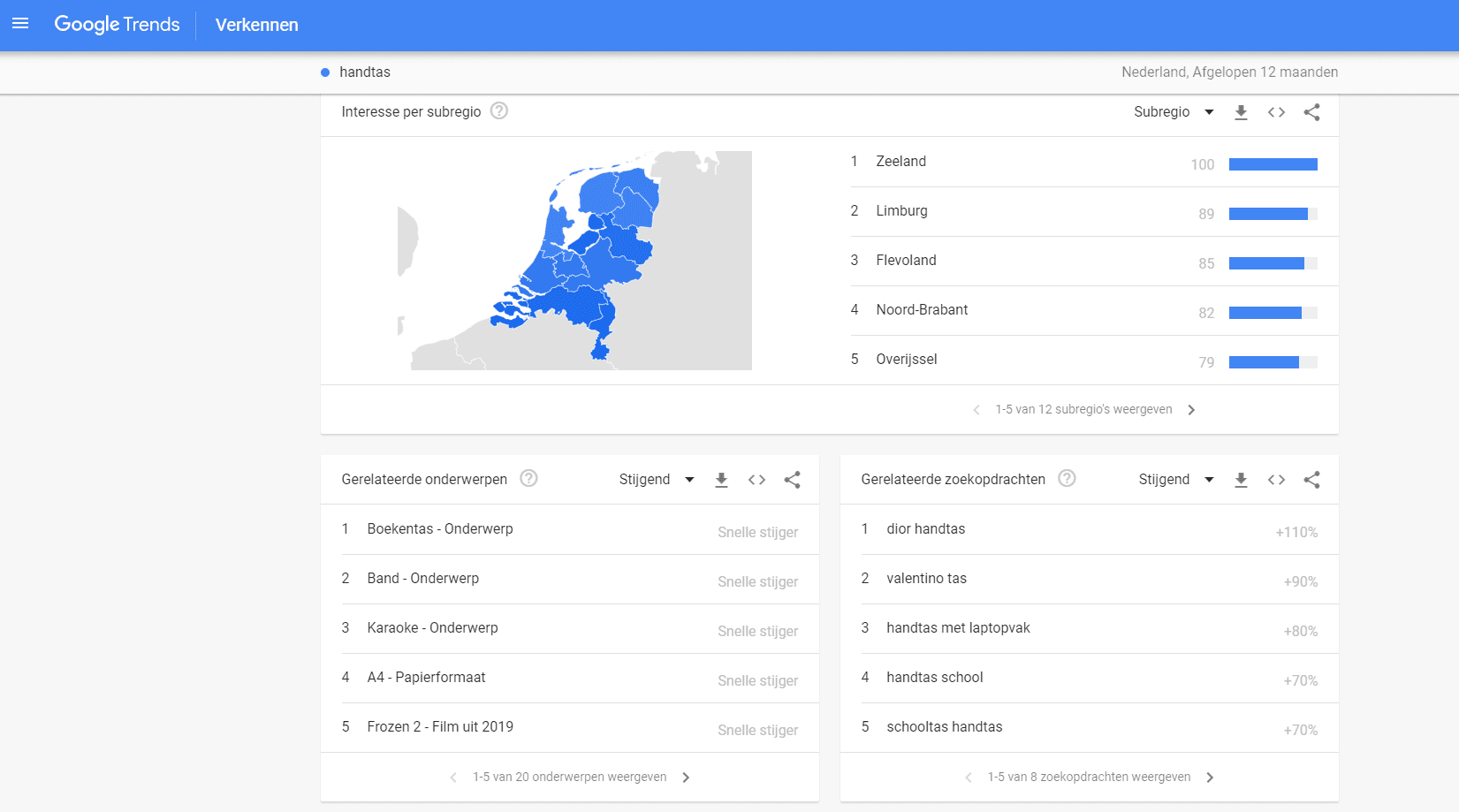
3. Check Google Trends
Once you've come up with a new product idea, it's smart to check how much demand for the product there is.
Google Trends is a great tool for finding out how often people search for an item. The free tool also shows whether search volume is rising or falling.
Keyword Planner (also from Google) shows you which search terms potential customers use, so you can set up targeted ads.
4. Pay your competitor a (virtual) visit
These days, the odds of finding an undiscovered niche are pretty slim, but a bit of competition isn't a bad thing.
For one thing, it means there's demand for the product, otherwise your competitors would have dropped the category already. So don't let other sellers scare you off.
Keep in mind that competitive markets often come down to economies of scale, since margins tend to be thin.
If you want to go head-to-head with large retailers, who can buy at sharp prices thanks to their high order volumes, you're probably better off looking elsewhere.
Unless you can add so much value to the product or the service level that people are willing to switch to you for it.
Sometimes small tweaks are all it takes to improve the product and give you an edge over the competition.
Here's an example: say you notice strong demand for quality bike bags. You could buy the same bags as your competitor. Or you could stand out by making sure your bags aren't just sturdy and waterproof, but can also be attached in multiple ways for extra convenience.
5. Look at other people's pain points
A less original, but often effective way to figure out what webshop to start or grow is to look at the pain points of current sellers.
Dig through review sites to see what consumers are unhappy about. This could relate to the products or the service.
Maybe customers want certain items delivered as fast as possible, and current sellers don't offer same-day delivery. That's your chance to fill the gap!
Current sellers often leave opportunities on the table, too. In more traditional markets, for instance, it's not unusual for players to be slow to embrace online opportunities.
For example, sellers often just reuse supplier images as-is, even though good product photography is a skill in itself.
More product variations, better lighting, and a more thorough product description can help you stand out, even when selling the same products.
Plenty of sellers also aren't making the most of social media, even though a growing share of shoppers buy through these channels.
Finally, you could bundle products that are often bought together into a set, which boosts your average order value.
Once economies of scale improve your profit margins, you could even lower your prices to get an extra edge over the competition.

In short: there's no shortage of new product opportunities
Hopefully this article helped you discover new product opportunities! As you can see, there are several ways to go about it.
And as you've read, it's best to combine multiple methods, like checking out influencer content and doing keyword research.
While e-commerce is already booming right now, there are still plenty of opportunities to seize.
Consumer needs around products and service keep changing over time, and so do e-commerce and logistics possibilities!
How do you spot new product opportunities as an (aspiring) online retailer? Let us know in the comments.
About the author: Dirkjan Vis
Dirkjan Vis is the founder and owner of Eurolutions.nl, an online publishing company based in Utrecht. Each month, he reaches around 300,000 business visitors through websites like Ecommercenews.nl, Ondernemeneninternet.nl, and Investeerders.nl.
PS. Also check out our article on the 15 biggest e-commerce trends for 2020 you can't ignore.

Author and researcher
How much time can you save on shipping?

Share
Recommended for you

Shipping Intelligence
Shipping
E-commerce
Best 9 Shipping Data Analytics Software Tools (2026)

VAT on shipping costs: how does it work?
Why do you pay VAT on shipping costs? Which VAT rate should you use, and how do you pass it on smartly to your customer? Find the answers in this guide.

5 tips to speed up your online store for more conversions
Speeding up your online store is essential for more conversions. Read 5 tips here that help you improve your site speed!