Best Shopify shipping apps: compare features, pricing & automation


Last updated:
TL;DR: The best Shopify shipping apps help merchants reduce manual work and manage couriers, labels, delivery options, tracking, returns, and international shipping more efficiently. Sendcloud brings these workflows together in one platform, combining multi-carrier flexibility with shipping automation and scalable delivery management.
Shopify gets you to market fast. Its built-in shipping tools cover the basics well — labels, rates, and access to a selection of couriers. For a new store with manageable order volumes, that's often all you need.
But shipping rarely stays simple. As your business grows, so does the complexity: more couriers, more countries, and more customers expecting delivery options that fit the way they shop. At some point, the manual workarounds cost more time and money — and can cost you customers, too.
That's where dedicated shipping apps come in.
In this guide, we compare the leading Shopify shipping apps: what each shipping solution does well, where it falls short, and the merchants it suits best. You'll find a full comparison table, mini-reviews of the leading Shopify shipping software, and a clear framework for choosing the right solution at your stage of growth.
All backed by insights from our Senior Global Partner Manager, Nick Buddingh, who knows Shopify's partner ecosystem inside out.
Let’s go!
When do you need a Shopify shipping app?
Shopify is built for commerce, with shipping as one part of the bigger picture. Shopify Shipping therefore works well when your shipping setup is straightforward. But a dedicated shipping platform goes deeper: more delivery options at checkout, cross-border shipping, courier flexibility, tracking, and returns.
The question is whether you've reached the point where those extra capabilities matter.
Here are some signs you may be ready for more:
You're shipping to multiple countries and/or choosing between multiple couriers manually
You're using 2 or more separate tools to manage labels, tracking, and returns
Fulfilment is taking hours out of your team's week
Customers expect more delivery options at checkout — express, next-day, pick-up points
It's getting harder to see what you're actually spending on shipping across couriers
These shipping challenges can quickly affect the customer experience:
Limited delivery options at checkout can lose you a sale before you’ve even shipped the order.
A missed delivery without a proactive update can quickly become a support ticket.
A return process that’s hard to navigate can make a customer think twice about ordering again.
The impact is measurable. How many shipping-related support tickets does your team handle each week? Are customers abandoning checkout because they can’t find a delivery option that works for them?
According to the E-Commerce Delivery Compass 2026, 48% of global consumers abandoned their basket because of a delivery reason in the past 3 months. That can quickly add up.
So, what exactly do you gain by adding a dedicated shipping app? Let's take a look.

Shopify Shipping vs a dedicated shipping app
A shipping app doesn't replace Shopify. It connects directly to your store and adds capabilities on top of Shopify Shipping — adding the courier flexibility, automation, and post-purchase tools that Shopify's native setup doesn't cover.
For a deeper look at how Shopify Shipping works and what it includes, see our Shopify Shipping Guide.
Capability | Shopify Shipping | Dedicated shipping app |
Courier access | Limited (depends on region) | Multi-carrier with a broad network |
Shipping automation | Basic | Automated rules and workflows |
Label creation | Basic | Batch labels and streamlined fulfilment |
Checkout experience | Limited to Shopify Plus | More delivery options, including pick-up points |
Tracking | Basic notifications | Branded, proactive tracking pages and updates |
Returns | Mostly manual | Self-service portals and automation |
Analytics | Limited | Shipping performance and cost insights |
Scalability | Suited for simple setups | Built for growing and international businesses |
The key takeaway: Shopify Shipping is the right starting point. But for growing businesses, shipping affects more than fulfilment — it directly influences checkout conversion, post-purchase loyalty, and how much time your team spends on tasks that could be automated. A dedicated shipping app gives you the flexibility to grow without those things becoming problems.
What to look for in a Shopify shipping app
Not all Shopify shipping apps solve the same problem. Some focus on creating labels. Others specialise in delivery options at checkout, tracking, returns, or international shipping. The right choice depends on where you need the most help — and how well the app fits into your wider shipping process, while connecting naturally to the rest of your Shopify setup.
Here's what to compare before making your choice:
Best Shopify shipping apps compared
Before we get into the detail on each app — from dedicated shipping platforms to Shopify fulfilment apps and checkout-rate tools — here's how they stack up at a glance.
Criteria | Sendcloud | ShipStation | Easyship | Shippo | AfterShip | nShift | Metapack |
Shopify integration | ⭐ Excellent | Excellent | Excellent | Excellent | Excellent | Good (complex setup) | Good (Delivery Options app only; labels need separate integration) |
Multi-carrier shipping | ⭐ Excellent | Excellent | Excellent | Excellent | Possible via AfterShip Shipping | Excellent | Excellent (350+ couriers, via separate integration) |
Shipping labels & fulfilment | ⭐ Excellent | Excellent | Excellent | Excellent | Possible via AfterShip Shipping | Excellent (separate subscription) | Good (requires separate OMS/WMS integration) |
Shipping automation & workflows | ⭐ Advanced | Advanced | Good | Basic | Basic | Advanced | Advanced (enterprise courier allocation) |
Courier coverage & flexibility | ⭐ Extensive (strong UK + EU network + own contracts) | Extensive (Royal Mail, DPD, Evri, Parcelforce, DHL, FedEx, UPS, InPost, Amazon Shipping) | Extensive | Good (limited UK couriers) | N/A | Extensive (merchant contracts, strong UK + Nordic/EU network) | Extensive (Royal Mail, Parcelforce, Evri, DHL, DPD + global; merchant contracts) |
Delivery tracking & returns | ⭐ Excellent | Good | Good | Good | Excellent (tracking) | Good (modular) | Good (modular — separate Track and Returns products) |
Delivery options & checkout | Excellent (pick-up points, delivery options) | Limited (no checkout rates for UK merchants) | Good (live checkout rates available) | Limited (no native checkout rates) | Limited | Excellent (native checkout, PUDO, rules, ETAs) | Excellent (delivery promises, PUDO, multi-warehouse; no dimensional pricing) |
International shipping | ⭐ Excellent | Excellent | ⭐ Best-in-class | Good | Limited | Excellent (190 countries, freight + customs) | Excellent (350+ couriers, global customs workflows) |
Pricing & scalability | Flexible SMB → Enterprise | Best for high-volume | Volume-based | SMB-friendly | Add-on pricing | Enterprise (custom pricing) | Enterprise (custom pricing) |
Best fit | ⭐ Growing Shopify merchants needing automation & multi-carrier shipping | High-volume fulfilment operations | Cross-border merchants | Small businesses | Brands focused on post-purchase experience | Established European merchants with complex courier needs | Large UK retailers with an OMS/WMS needing enterprise courier orchestration |
Best for UK | ⭐⭐⭐⭐⭐ | ⭐⭐⭐⭐ | ⭐⭐⭐⭐ | ⭐⭐⭐ | ⭐⭐⭐ | ⭐⭐⭐⭐ | ⭐⭐⭐⭐ |
In-depth reviews of the leading Shopify shipping apps
Sendcloud
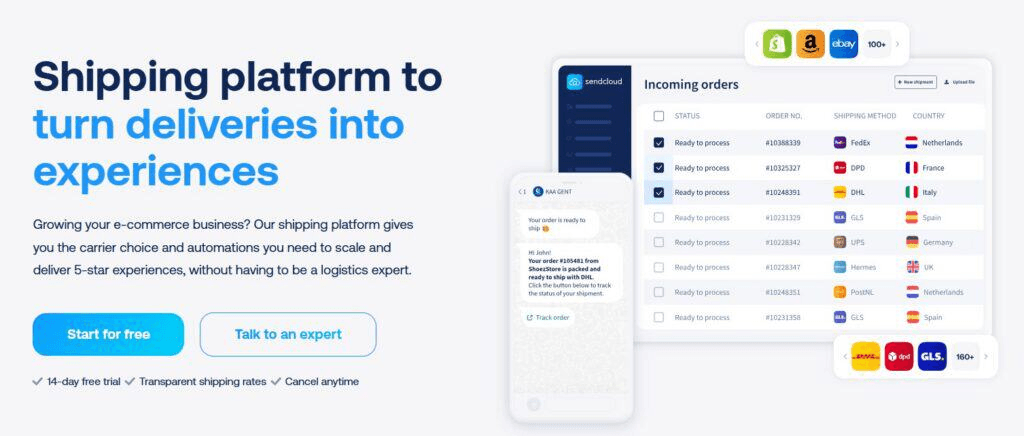
Founded in the Netherlands in 2012, Sendcloud serves 30,000+ merchants — including 10,000+ active Shopify stores across 8 countries, with a 4.6 rating on the Shopify App Store.
It’s built around one idea: covering the full Shopify shipping workflow in a single platform. That means checkout delivery options, 170+ couriers, label generation, warehouse fulfilment, branded tracking, returns, and 390,000+ service points across Europe — without needing a separate app for each.
What sets it apart is how it connects with the tools merchants already use. Sendcloud integrates with Klaviyo for post-purchase marketing, Gorgias for shipping-related customer support, and returns platforms like Loop, Returnless, and ReturnGo. Shipping data flows across your stack rather than sitting in a silo.
Pros:
Full shipping workflow in one platform — checkout, labels, fulfilment, tracking, and returns without needing separate tools
Exceptional courier and service-point coverage: 170+ couriers and 390,000+ pick-up points across Europe
Pick-up point selection before payment for Shopify Growth & Advanced plans Warehouse automation tools including Pack & Go, barcode scanning, and bulk labels
Bring-your-own-courier flexibility — use Sendcloud's rates, your own contracts, or both
Connects with Klaviyo, Gorgias, Loop, ReturnGo, and more, so shipping data flows across your stack
Cons:
Pricing has multiple components — subscription fee, per-label platform fee, and courier postage are charged separately
Key features like Pack & Go, branded tracking, and advanced returns are plan-dependent
Some checkout features, including map-based pick-up point selection, require Shopify Plus
Pricing: Free plan up to 20 parcels/month. Paid plans from €28/month (Lite), €87 (Growth), €175 (Premium), and €639 (Pro). Annual billing saves 20%.
Best for: Growing Shopify merchants in Europe that want to replace a patchwork of apps with a single platform covering checkout, multi-carrier shipping, automation, tracking, and returns.
ShipStation
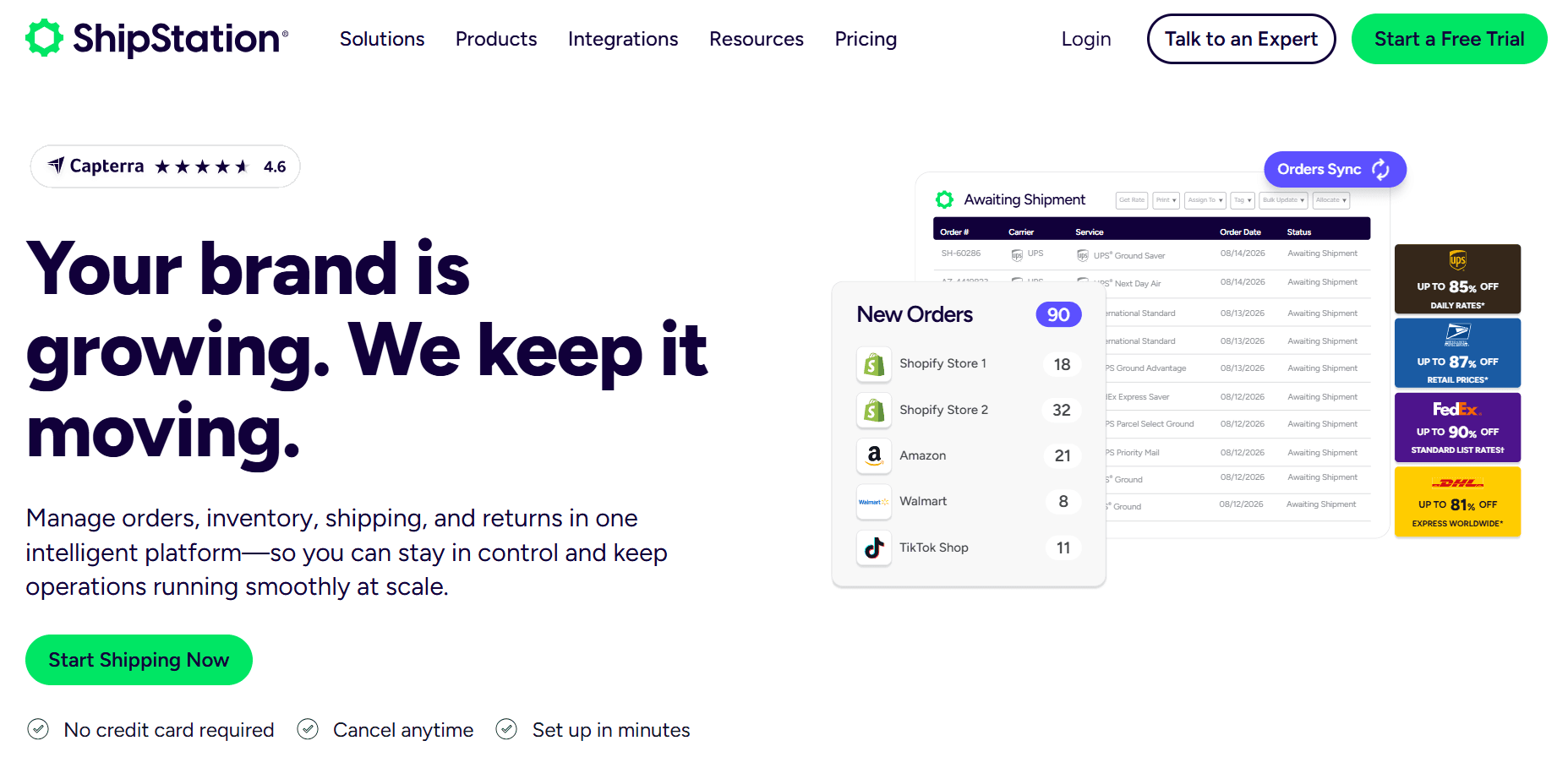
ShipStation centralises orders from Shopify and other sales channels, handling label creation, fulfilment automation, tracking, returns, and international shipping. In the UK it connects to Royal Mail, DPD, Evri, Parcelforce, DHL, FedEx, UPS, InPost, and Amazon Shipping, with 200+ couriers globally.
Pros:
Deep Shopify integration with order sync, fulfilment updates, and POS support
Unlimited store connections from the entry-level Starter plan
Solid automation on Standard and above, including custom rate shopping and own courier accounts
International customs tools: HS codes, VAT/EORI support, and electronic customs submission
Cons:
Shopify checkout rates are only available for accounts in the US, Canada, Australia, and New Zealand — not UK or EU merchants
Branded tracking, full automation, and the return portal all require Standard or higher
Pricing scales with shipment volume, which can add up for high-volume operations
Pricing: Free plan (50 shipments, one store); Starter from £10/month; Standard from £25/month; Premium from £270/month. Annual billing saves 20%.
Best for: Multichannel Shopify merchants with substantial label volume and warehouse needs, particularly in the UK. Less suited to European merchants prioritising checkout delivery options.
Easyship
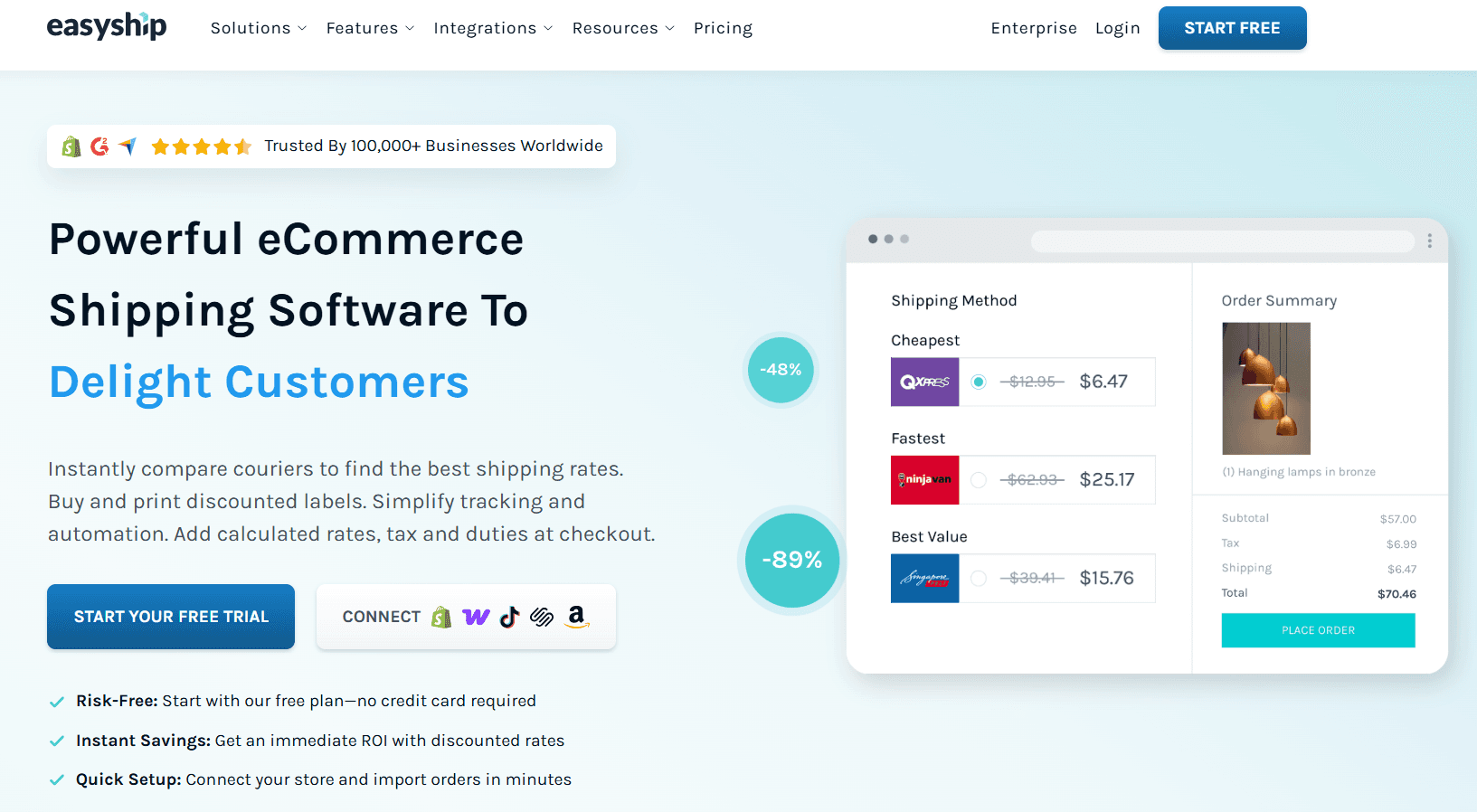
Easyship focuses on international e-commerce, combining label creation, live checkout rates, automation, tracking, returns, and customs tools. It connects to 550+ courier services globally and serves more than 100,000 businesses.
Pros:
Duties, taxes, and customs documentation are core features, not add-ons
Live checkout rates available internationally — not restricted to specific account countries like some competitors
Flexible checkout controls including free-shipping rules, mark-ups, and estimated duty display
Cons:
Live checkout rates require Shopify Advanced or Plus
Automation requires Plus or higher; displaying duties at checkout requires Premier
Local European courier depth varies by shipping origin — worth verifying before committing
Pricing: Free plan available. Paid plans (Plus, Premier, Scale) with pricing that varies by shipping origin. Annual billing saves 21%.
Best for: Internationally focused merchants that want broad courier comparison, dynamic checkout rates, and built-in customs functionality. Merchants shipping primarily within Europe should verify local courier availability for their origin country before committing.
Shippo
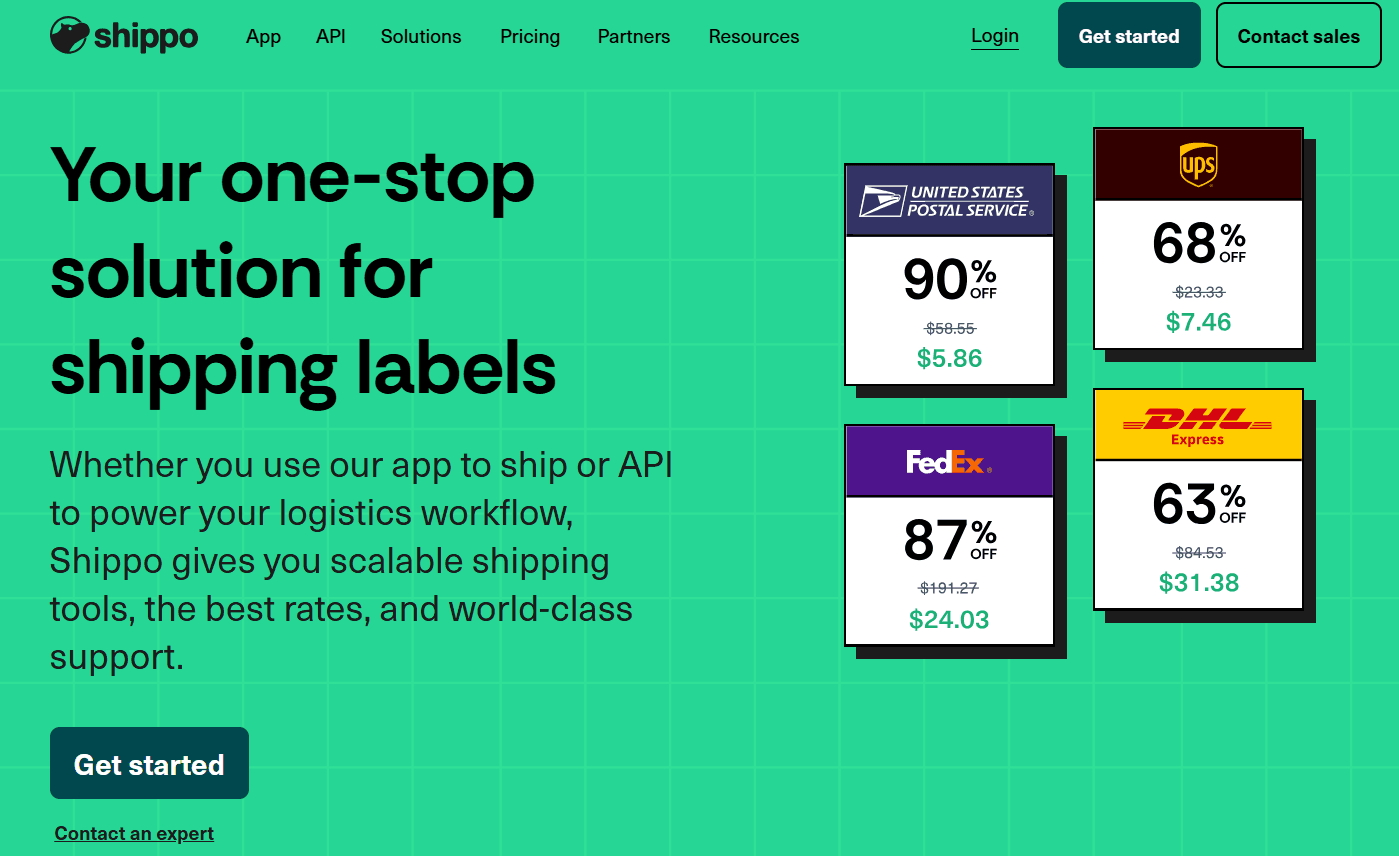
Used by more than 4.6 million businesses, Shippo connects Shopify stores for order import, rate comparison, label creation, tracking, returns, and international customs documentation across 40+ couriers.
Pros:
Solid free plan with unlimited store connections, automation, and return labels (up to 30 labels/month)
Good multi-location support — Shopify locations import automatically and orders can be split by location
Existing courier accounts supported on every plan, including Starter
International documentation — customs forms, commercial invoices, and VAT/EORI identifiers — included across plans
Cons:
No native Shopify checkout rates
European courier coverage is limited to a few couriers per country (France, Germany, Belgium, Italy and the UK, with no Netherlands-specific courier listed)
Branded tracking and self-service returns require Pro
No self-service return portal
Pricing: Starter free. Pro from $19/month (up to 10,000 labels, branded tracking, own courier accounts). No euro pricing published.
Best for: Small and growing merchants that want an accessible multi-carrier label platform with a solid free tier. Less suitable for merchants who need Shopify checkout rates, pick-up point selection, or broad European courier coverage.
AfterShip
AfterShip is structured as 3 separate products — Shipping, Tracking, and Returns — each with its own subscription and usage quota. A merchant wanting all 3 needs multiple plans.
Pros:
Excellent tracking coverage across 1,300+ couriers with branded pages, delivery-exception alerts, and AI-predicted delivery dates
Strong returns product: self-service portal, eligibility rules, automatic approvals, exchanges, and store credit
Unlimited Shopify store connections across all plans
Cons:
3 separate subscriptions needed for the full suite — Shipping, Tracking, and Returns are priced and metered independently
The 1,300+ courier figure refers to tracking, not labels; AfterShip Shipping connects to 100+ label couriers
No documented native Shopify checkout-rate integration or pick-up point selection
Usage allowances are annual, not monthly — which can catch merchants off guard
Pricing: All plans on annual billing. Shipping from $9/month (1,200 labels/year); Tracking from $29/month; Returns from $16/month. A merchant running all 3 entry plans pays $54/month combined. No euro pricing published.
Best for: Brands focused on post-purchase experience — particularly those that want branded tracking, proactive delivery notifications, and sophisticated returns alongside label generation.
nShift
nShift is a European delivery-management platform built from five combined businesses including Unifaun, Consignor and Webshipper, with roots dating back to 1997. It connects Shopify to a network of 1,000+ couriers and 10,000+ services across 190 countries, with particular strength across Northern and Western Europe.
Pros:
Native Shopify checkout integration with home delivery, express, and PUDO options, including prices, estimated delivery times, and pick-up point details
Advanced checkout rules by market, postal code, basket value, and product attributes, configured without custom development
1,000+ courier connections maintained centrally, covering parcels, freight, and last mile across Europe
Multi-warehouse rate calculation — different rates can be returned per fulfilment centre
Cons:
Modular platform: Checkout, labels, tracking and returns may require separate subscriptions and agreements
The Shopify Checkout app does not support Shopify Basic
Labels and fulfilment require nShift Delivery or Webshipper, not included in the Checkout subscription
No public pricing — custom quotation required for the full Shopify solution
Pricing: Custom quotation. A regional self-service calculator lists nShift Delivery from €31/month at 1,000 parcels/year — but Checkout, tracking, returns and full platform pricing require a direct quote.
Best for: Established European Shopify merchants with multiple couriers, countries, or warehouses that need sophisticated checkout delivery options and scalable courier orchestration — particularly those with existing courier contracts.
Metapack
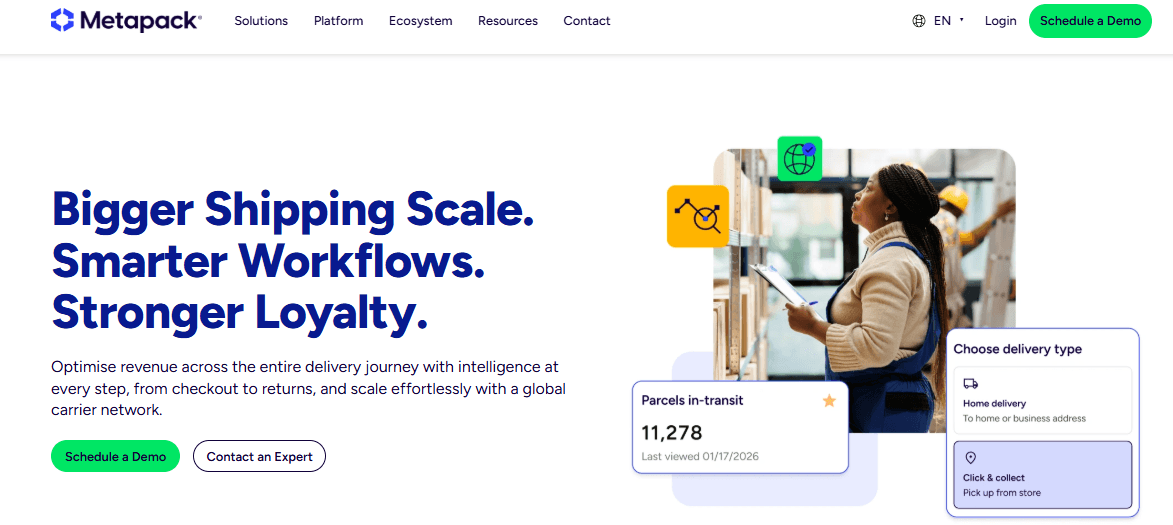
Metapack is a London-based enterprise delivery management platform founded in 1999, now part of the ShipStation Global group. Its free Shopify app connects to Metapack's Delivery Options product, showing validated delivery promises — including home delivery, express, named-day, and pickup points — directly on product pages and at checkout, across both standard Shopify and Shopify Plus.
Pros:
Validated delivery promises on product pages and at checkout, with accurate ETAs and PUDO details across multiple warehouses
350+ couriers and 4,000+ services, with particularly strong UK coverage including Royal Mail, Parcelforce, Evri, DPD and DHL
Advanced delivery rules by market, destination, cart value and product — supporting multilingual and multi-warehouse setups
Enterprise-grade courier orchestration through Metapack Delivery Manager, covering allocation, labels, customs and international routing
Cons:
The Shopify app handles delivery options only — labels, fulfilment, tracking and returns all require separate Metapack products and a distinct integration
No public pricing — the full Shopify solution requires a custom quotation, and implementation is more involved than a standard shipping app
Merchant carrier contracts required — Metapack provides connectivity and orchestration, not bundled postage rates
Pricing: Custom quotation. The Shopify Delivery Options app is free to install but requires a commercial Metapack agreement. Delivery Manager, tracking, returns and the separate fulfilment integration may add further licensing and implementation costs.
Best for: Large Shopify and Shopify Plus retailers already using an OMS or WMS that need enterprise-grade delivery promises and multi-carrier orchestration — particularly UK merchants with complex courier setups.
Also worth knowing: PUDO apps
If adding pick-up point selection to your Shopify store is a priority, 2 dedicated apps are worth knowing. Octolize Pickup Points PRO covers 54 couriers, works across all Shopify plans, and starts at $9.99/month. Atlas Pickup Points covers 60+ couriers across 36 countries and starts at $39/month, with a more polished in-checkout experience on Shopify Plus.
Neither is a shipping platform — they handle pick-up point selection only, so you'll still need a separate solution for labels, tracking, and returns. Merchants running Sendcloud get pick-up point selection included without an extra subscription.
Why Sendcloud is the best Shopify shipping app for growing merchants
Most tools in this comparison do one or two things well. Labels. Checkout rates. Tracking. But they leave the rest to other software — which means more subscriptions, more manual handovers, and more things to go wrong.
Sendcloud is built around the whole picture. From one platform, you can manage delivery options at checkout, ship with 170+ couriers, automate label creation and fulfilment tasks, track parcels, handle returns, and offer delivery to 390,000+ service points. Integrations with Klaviyo, Gorgias, Loop, and ReturnGo connect shipping with the tools your marketing, support, and returns teams already use.
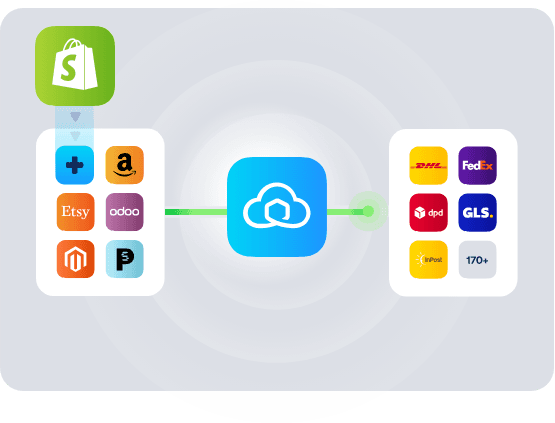
Today, 10,000+ active Shopify merchants across 8 countries use Sendcloud, and the app has a 4.6 rating on the Shopify App Store. Getting started is straightforward, too: merchants can connect from the Shopify App Store and the Smart AI onboarding lets them start shipping in just a few clicks.
For European Shopify merchants that have outgrown a single-courier setup or a mix of separate shipping tools, Sendcloud gives you more ways to automate your shipping and manage it in one place — without having to rebuild your setup as you grow.


Author and researcher
As Global Content Manager at Sendcloud, Johanna leads content strategy across e-commerce, logistics, and shipping automation. With a background in B2B SaaS and a passion for clear communication, she creates educational resources that help over 30,000 online stores optimize and scale their shipping operations.

Subject matter expert
Partner Marketing Manager at Sendcloud, Clíodhna shares valuable industry insights from top e-commerce experts.
How much time can you save on shipping?

Share
Recommended For You

Shipping
Integrations
Best Shopify shipping apps: compare features, pricing & automation
Compare the best Shopify shipping apps for automation, couriers, labels, tracking, returns and international shipping. Find the right app for your store.

Shipping
Shopify shipping automation: How to automate your fulfilment workflow
Learn how Shopify shipping automation helps you automate fulfilment workflows, reduce shipping errors, save time, and scale with Sendcloud.

Shipping Intelligence
Shipping
E-commerce