Consumer trends in e-commerce 2026: What European shoppers really want


Last updated:
TL;DR: Customer delivery expectations in Europe have never been higher. Based on a survey of 8,000 shoppers across 8 European markets, Sendcloud's E-commerce Delivery Compass 2026 reveals what drives purchases, what causes cart abandonment, and where loyalty is won or lost after the checkout. From the rise of AI-assisted shopping to the growing weight of international commerce, this article covers the key consumer delivery trends shaping e-commerce in 2026, and what merchants need to do about them.
Nearly half of European shoppers abandoned a shopping cart due to a delivery issue in the past three months, proof that consumer trends in e-commerce now revolve around delivery. Not because the product was wrong. Not because the price was too high. Because of delivery.
Consumer expectations have fundamentally changed, and they’re now shaping every stage of the buying journey. What used to be a back-end operation has become a decisive moment: where conversion happens, where loyalty is built (or lost), and where retailers gain a real competitive edge.
To understand the consumer trends in e-commerce shaping 2026, we surveyed 8,000 consumers across 8 European markets as part of our E-commerce Delivery Compass report. The findings are clear and actionable.
In this article, you’ll find the most important e-commerce consumer trends that shape delivery performance in Europe today in 4 themes. From how consumers behave, to what they expect at checkout, to how delivery costs and the post-purchase experience influence their decisions.
The delivery gap: what European shoppers expect vs. what they get
Before diving into the four themes, it’s worth calling out the central finding that connects them all.
Consumer trends in e-commerce in 2026 point to one clear truth: uncertainty kills conversion. Whether at checkout, during transit, or at the returns stage, the data consistently show the same pattern. Shoppers are willing to wait. They’re willing to pay. They’re even willing to try something new, but only when they know what to expect. The moment that certainty disappears, so does the sale
This indicates a gap between what consumers expect and what merchants deliver. On a positive note, it’s measurable and fixable.
In this report, we’ll give you the data and insights you need to close that gap and align your delivery experience with real customer expectations.
The European shopping landscape in 2026
Before looking at what shoppers want from delivery, it helps to understand how they shop — and how online shopping trends are shifting.
One of the clearest shifts in the data is the rise of AI-assisted shopping. 43.04% of European shoppers have already used an AI tool like ChatGPT, Google Gemini, or Perplexity to decide where to buy a product, and 18.75% say it directly influenced their final decision.
Another 39.02% use AI to evaluate delivery options before buying, comparing speed, cost, and available methods to choose a retailer. Spain leads in AI adoption (52.34%), while Belgium and Austria show the most resistance.
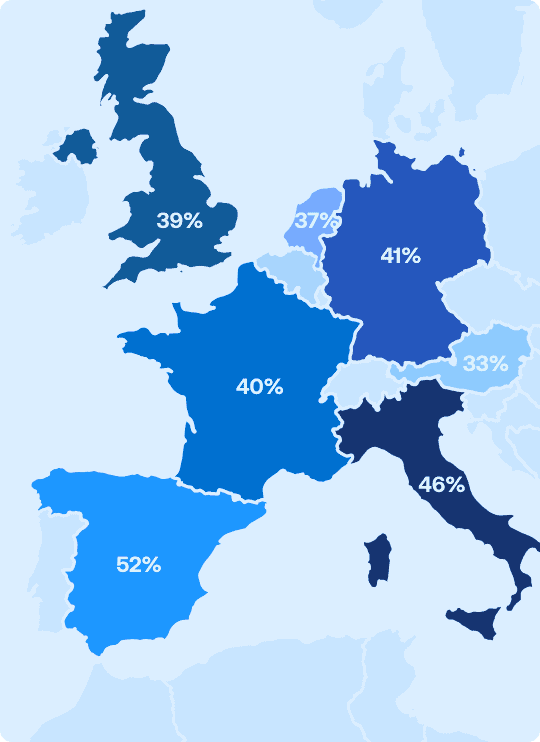
AI-assisted shopping is already mainstream in Southern Europe, with Spain and Italy leading adoption.
This shift is still early, but it’s picking up fast. The retailers who will win are the ones that make delivery information easy to understand and compare. Delivery transparency now plays a role much earlier in the journey, shaping how shoppers decide where to buy.
Consumer expectations: what actually drives decisions at checkout
Checkout is where most delivery revenue is lost, and most of the causes are preventable.
48.17% of European shoppers abandoned a cart due to delivery in the past three months. In Spain, that figure rises to 55.73%. In the UK, 54.52%. These are not one-off events: 20.32% abandoned two to three times in the same period.
So what’s driving it? 40.70% of shoppers point to unexpected delivery costs as the main reason for abandoning. Not high delivery costs, but unexpected ones. Prices that appear only on the payment screen, after the shopper has already decided to buy. This is a UX failure, not a logistics one.
Consumer behavior trends around speed are more nuanced than they seem. Yes, 36.90% of shoppers globally expect domestic delivery within 2–3 days. But when given the choice, 71.76% prefer free delivery to paid next-day delivery. What they actually want is free delivery with a clear delivery date.
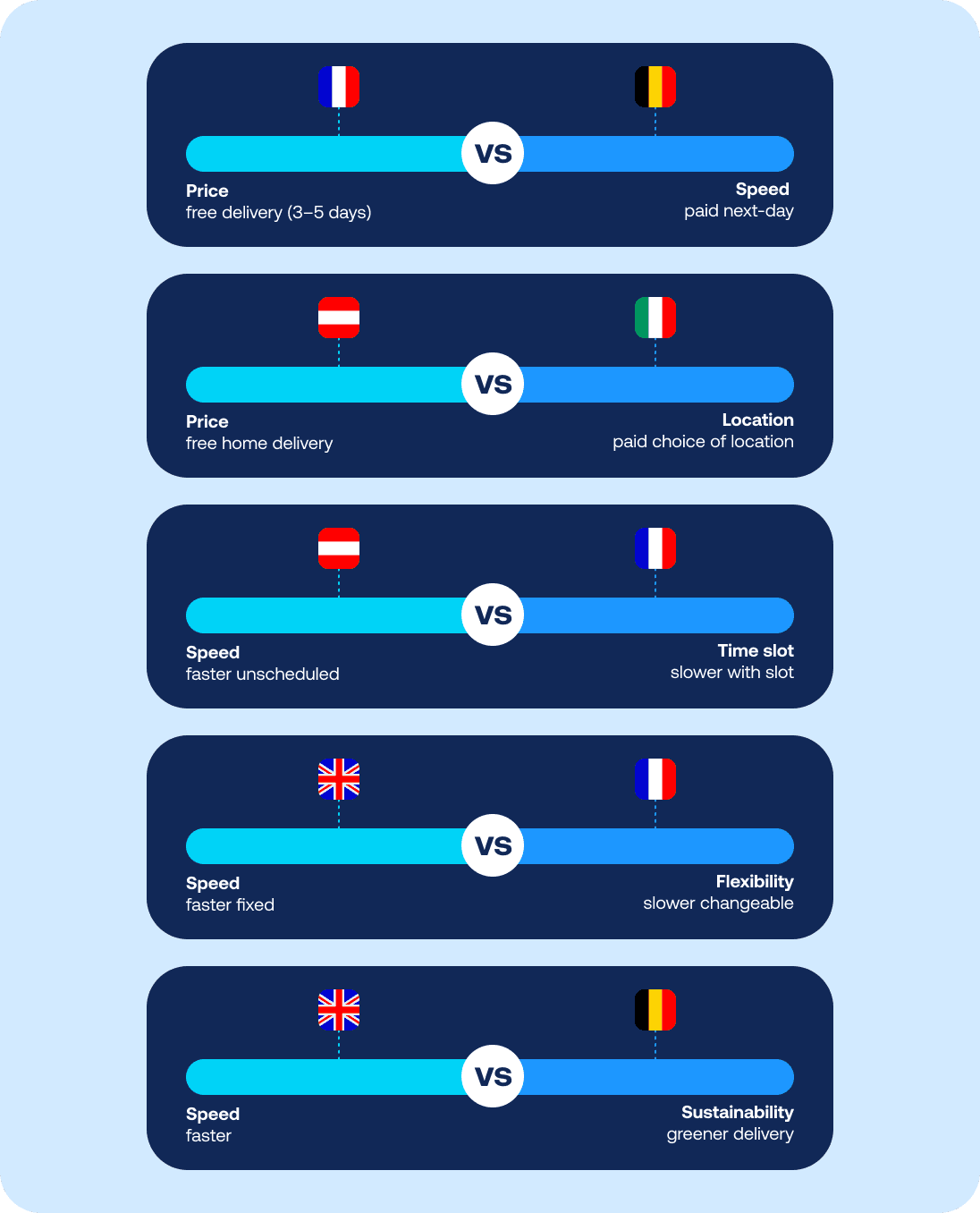
Offering multiple delivery options has a clear impact on conversion. 50.51% of shoppers are more likely to complete a purchase when they can choose between options. This increases to 72.16% in France, 70.72% in Spain, and 70.38% in Italy.
But what options are shoppers actually asking for? Standard home delivery is still the top choice at checkout (30.60%). Next comes next-day delivery (10.69%), service point pick-up (10.27%), parcel locker delivery (9.16%), and nominated day delivery (8.77%). The range matters: shoppers are not just choosing between fast and slow. They are choosing between home and out-of-home, between control and convenience, between cost and flexibility.
That shift is already visible in real behavior. When you look at actual delivery behavior rather than stated preferences, 54.66% of European shoppers used standard home delivery in the past three months. But 45.34% chose an alternative location: service point pick-up (17.97%), parcel locker (15.49%), or local shop collection (11.88%).
Almost half the market is already using out-of-home delivery options. Retailers that only offer home delivery are missing a significant share of demand.
The takeaway: The highest-impact improvements are also the simplest. Show a specific delivery date at checkout. Be upfront about delivery costs earlier in the journey. Offer at least three options: home delivery, one out-of-home alternative, and a faster delivery upgrade.
The post-purchase experience: where loyalty is won or lost
The checkout is where the purchase happens. The post-purchase experience is where you retain the customer or lose them forever.
77.07% of European shoppers experienced at least one issue with their most recent delivery. Think of late arrivals, date changes, confusing tracking, and damaged parcels. That means only around one in four deliveries goes completely smoothly.
The impact on retention is immediate: 29.06% of shoppers chose not to reorder from a store after a delivery failure, which is nearly one in three customers lost.
Here’s where many retailers get it wrong. 42.46% of shoppers hold the online store responsible for delivery problems, even when the carrier handles the delivery. In the Netherlands, that rises to 50.91% and to 50.68% in Belgium. Retailers might outsource the last mile but retain the reputational risk. The only practical response is to own the communication layer.
Three updates are expected as standard by most European shoppers:
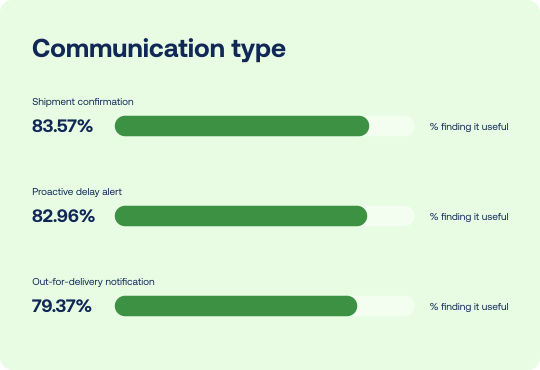
They are the non-negotiable baseline. Any retailer not sending all three is falling short of customer expectations.
Getting this right has a clear impact on loyalty. 76.64% of shoppers are more loyal to stores that handle delivery issues transparently. Proactive communication during a delivery issue reduces complaints while keeping customers coming back.
Returns complete the picture. 41% of European shoppers made at least one return in the past three months, and 70.73% say they are more likely to buy from stores that offer easy online returns.
The paradox worth noting: France has the lowest return rate in the survey (31.89%) but the highest purchase intent driven by easy returns (81.60%). French shoppers don’t need to return frequently; they need to know they can before they commit.
The takeaway: Post-purchase communication is the most cost-effective way to improve retention. Clear tracking, proactive delay alerts, and an easy-to-find returns policy cost far less than the customers lost when things go wrong.
The global shopping shift: international commerce and the China effect
Consumer trends in e-commerce don’t stop at domestic borders. International e-commerce is already part of everyday shopping. 64.09% of European shoppers ordered from a store outside their country in the past six months.
But that behavior is fragile. It depends on shoppers feeling protected from surprises, and right now, many don’t.
China is the leading source of international purchases (34.10% globally), driven by platforms like Temu and Shein. This is a structural competitive reality for European retailers. These platforms have normalized cost absorption, long-but-free delivery, and the promise of easy returns. Especially in categories like apparel, accessories, and home goods, where European retailers compete directly. They have reset what “good enough” looks like for international purchasing.
In practice, returning an order to a Chinese platform is rarely as simple as it looks: international return shipping, narrow refund windows, and slow processing times are common frustrations. But the perception is powerful enough to shape expectations, and European retailers are being measured against a benchmark that isn’t always what it claims to be. For merchants who can offer genuinely easy, local returns, that gap is a competitive opportunity.
What’s holding shoppers back from ordering internationally? Higher delivery costs (18.88%), longer-than-expected delivery (16.71%), unexpected customs duties (16.20%), and complicated returns (13.48%).
The fixes they want are almost exactly the mirror image: transparent duties and taxes shown upfront (20.24% would order more internationally for this), guaranteed delivery dates with compensation (19.77%), and easy returns with local drop-off (18.24%).
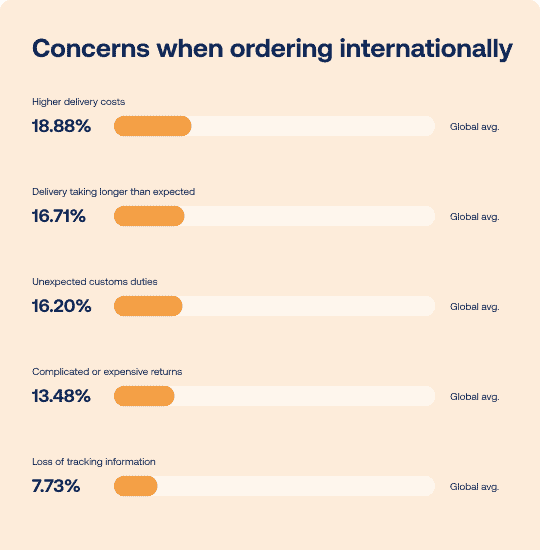
For international shoppers, the key questions are simple. What will I pay? When will it arrive? What happens if I need to return it?”
The takeaway: The barriers to international e-commerce are not primarily logistical. They are informational. Show the full cost upfront. Be clear about delivery timing. Make returns easy. Retailers who remove uncertainty will capture international demand.
For a full breakdown of how to build an international strategy that addresses these barriers, see our international shipping guide for e-commerce.
What these consumer trends mean for your shipping strategy
The E-commerce Delivery Compass points to a delivery gap: the distance between what European shoppers expect and what they consistently receive.
That gap shows up everywhere. In checkout abandonment. In post-delivery churn. In hesitation around international purchases. And in the limits of one-size-fits-all fulfillment strategies.
The good news is that it’s fixable.
The retailers who will win in European e-commerce won’t just compete on speed or price. You’ll win by getting the delivery experience right.
That means showing the right delivery information at the right moment. Communicating early when something goes wrong. Making returns simple before your customers even think about them. And adapting your delivery strategy to how shoppers behave in each market you operate in.
Shipping isn’t just something you manage anymore. It’s one of your strongest levers for conversion and loyalty. And the data to get it right is already here.
Building your Shipping Formula
The E-commerce Delivery Compass 2026 is the consumer side of Sendcloud’s Shipping Formula. It’s our framework for helping you design delivery around your shoppers, not just manage it behind the scenes.
It starts with a simple question. What actually matters to your customers when it comes to delivery? How do they weigh speed, cost, and convenience? And what does that mean for how you design your checkout, your communication, and your fulfillment strategy?
The E-commerce Delivery Compass data gives you those answers. Across 8 markets, 8,000 online consumers, and every key delivery moment from checkout to returns.
If you treat shipping as a designed experience, you’ll see the impact. Balance the right options. Be clear about costs. Communicate when it matters. Deliver consistently. That’s what drives performance.
Treat it like a commodity or operational task, and you’ll fall behind.
The E-commerce Delivery Compass 2026 is the first report in the Shipping Formula series, which helps us understand what your customers want.
Ready to go deeper? Download the full E-commerce Delivery Compass 2026 report.


Author and researcher
Marina Fernández leads the Communications craft, creating e-commerce, B2B, and SaaS content. She ensures that every piece of content is of the highest quality and effectively meets its intended purpose.

Subject matter expert
Partner Program Manager at Sendcloud. On our blog, Kate shares valuable industry insights from top e-commerce experts and influencers.
How much time can you save on shipping?

Share
Recommended for you

Over the Past Three Months, Nearly One in Two European Consumers Have Abandoned an Online Purchase Because of Delivery
48% of European consumers abandon online purchases because of delivery: unexpected costs, long delivery times, and lack of choice.

Consumer trends in e-commerce 2026: What European shoppers really want
We surveyed 8,000 European shoppers to map the biggest consumer trends in e-commerce, from checkout to post-purchase, loyalty, and returns.
E-commerce monitor 2026: The era of automatic growth seems over
The E-commerce Monitor 2026 shows webshops focusing less on fast growth and more on profitability, customer retention, and efficiency. Discover the key trends.