


Shipping parcels is an incredibly important but often laborious process for anyone running a webshop. We're happy to give you a hand in making shipping your parcels easier. That's why we're sharing the ultimate webshop checklist to help you run your shipping process as efficiently as possible. That way, you can focus on what really matters for your shop.
The ultimate webshop checklist
Every day you're busy purchasing your products, creating ads, writing the right product descriptions, optimizing based on your visitor numbers, putting together newsletters and much more.
All this energy will hopefully bring in lots of orders. And in the end, those orders also need to reach your customer. So how do you still find time to ship these orders? An order isn't complete until it reaches your customer. And shoppers want to have a say in that too.
They want to choose for themselves how, where and when they receive their order. That's why in 2017 we can say that your shipping process and strategy can make or break your webshop. So don't leave your shipping strategy to chance.
In this blog post, we share a webshop checklist for shipping your orders, so you can run a profitable shop.
1. Match your products with the best carrier(s) for you
Which carrier will you work with to make sure your parcels are delivered to the customer? It's still often forgotten that matching products with the available carriers is an essential part of your shipping strategy.
Choosing the right carrier(s) can be tricky, because they all have unique advantages and the differences are in the small details. That's why we wrote about the advantages of each carrier before. In your Sendcloud environment, you can combine:
DHL
bpost
DPD
UPS
Want to offer shipping to pickup points? By shipping with multiple carriers, you can offer your customer multiple pickup points. That way, your customer can easily select the nearest pickup point.
A number of factors determine the price you pay per shipped parcel:
Weight of the parcel. Often 20kg or 30kg is allowed.
Size of the parcel. For example, PostNL has a maximum size of 100x70x58cm.
Country you ship the parcel from.
Country the parcel is going to.
With or without a tracking code, for example for mailbox parcels.
With or without insurance.
So which carrier is the most cost-effective depends entirely on what you ship. We've developed a handy tool that lets you compare prices yourself based on the shipping route and packaging type:
2. Delivery options in the checkout: choice is conversion!
Now that you've chosen the carriers you'll offer, you need to add them to your webshop. Before you can ship any orders, the customer of course has to complete the full checkout. Which shipping options do you offer? Express delivery, same day delivery and/or pickup point delivery.
By adding a shipping method that appeals to your customer on the product page itself, such as “order before 18:00 today, delivered tomorrow”, you boost conversion. In any case, give your customer a choice, otherwise your competitor is unfortunately just a few clicks away.
You add your shipping method(s) to your checkout through your shop system. Another option is to work with a shipping plugin like the one from Sendcloud. Your shipping options are then automatically integrated into your checkout.
3. What about the shipping costs in your webshop?
Once you've added shipping options to your checkout, you need to decide whether and how you'll pass shipping costs on to your customer. The shipping costs in your webshop have a big impact on your actual conversion. Say your visitor finds the product they want, at the price they want, and adds it to their shopping cart.
Then they go through the checkout process, and that's when it happens. Your visitor is unexpectedly surprised by shipping costs, and suddenly the total price of the product isn't so attractive anymore. The result? Your visitor abandons the shopping cart.
Your shipping cost strategy stands or falls with the communication in your online store. Communicate about the shipping options and costs on the product pages and in the checkout.
We've listed the three most common shipping cost strategies for you:
Free shipping: It's been proven that offering free shipping increases conversion. In your case, free shipping (unfortunately) means the costs are entirely on you. Whether this is feasible depends on your margins. Another option is to raise the prices of your products slightly. The downside is that prices can be compared directly online, so a sales price that's too high isn't always an option. On top of that, free shipping often isn't an option for extra heavy products, such as furniture, because the shipping costs are considerably high. In that case, we recommend choosing a different strategy for your webshop, such as free shipping above X euros.
Free shipping above X euros: Offering free shipping above a certain amount comes with a number of advantages. You can promote free shipping in your webshop, and that grabs attention. It also encourages cross-selling or upselling, which in turn leads to an increase in average order value. Look at the average order value in your webshop and decide at which average order value it's feasible for you to offer free shipping.
Flat-rate shipping: 24% of webshops use flat-rate shipping costs. For example, you charge a standard €3.95 for shipping your products. However, this can take a big bite out of your conversion, because free shipping is almost the norm. In any case, we recommend never passing on the full shipping costs you pay yourself, and covering part of them instead. Test the price and its effect on your conversion rate to determine what works best for your products and webshop. Do you sell relatively expensive products? Then we advise against charging flat-rate shipping costs.
When should you offer free shipping?
Not sure what's best for your webshop? Then we have a good rule of thumb for you. When shipping costs are higher than 10% of the purchase price, the customer is more likely to leave the checkout (for international shipments this can go up to 30%).
We also recommend offering free shipping during the holidays, when you can generate and encourage extra sales. Research by David Bell shows that free shipping that saves your customer €6.99 is more appealing than a €10 discount.
4. Successful shipping? Not without a well-packed product
As soon as your customer has successfully completed the checkout, the order comes into your webshop. How the rest of the shipping process goes depends on how your product is packaged. You need to pack your product safely and securely. After all, that's your responsibility.
Don't meet the packaging requirements? Then there's little chance your product will arrive at your customer in good condition. We've listed the most important packaging tips for you.
Use a sturdy shipping box or a padded envelope. Limit the space between your product and the packaging to 6cm, so you can fill the space with styrofoam or bubble wrap.
Use strong tape at least 48mm wide to prevent the box from tearing open.
For fragile products, it's best to use (corrugated) cardboard made up of multiple layers. Note: fragile goods are excluded from compensation for damage by default, unless a packaging agreement has been made with the carrier.
Meet the carrier's packaging requirements. You usually pay based on the size and weight of your parcel. Always make sure your parcel meets the weight and size conditions. Is your parcel bigger or heavier than allowed? Then the carrier will charge surcharges.
A well-packed product?
You know your product is well packed when you dare to drop the parcel on every side! Millions of parcels are processed in the sorting centers. Always keep that in mind when you pack your parcel.
Your packaging as a marketing strategy
You can set your webshop apart from your competitor and encourage word-of-mouth by going that little bit extra with your packaging. In physical stores, customers can be given a shopping experience and a “fun” element so they come back again. In webshops, that's harder.
With beautiful packaging, you can give your customer an extra “experience” when they receive your product. A good example is the webshop Guts & Gusto, which packs its products in extra festive packaging with a personal note.
Customers share their fun experience on social media in droves, and that gets you free publicity too. Instead of beautiful packaging, you can also choose to add a card to the box and surprise your customer. As long as it's personal!
5. Additional insurance?
It's still often forgotten, but your parcels aren't insured by default. Do you ship high-value products? Then we always recommend insured shipping. If your customer doesn't receive their parcel, they won't be understanding about it. The worst result is a negative review, even though it isn't your fault.
First, look at the shipping option you ship with. Some options are insured up to a certain amount by default. You also have the option to insure each parcel. With insured shipping through Sendcloud, you decide for yourself what amount to insure your shipment(s) for, at an affordable rate.
If something then goes wrong with your parcel and you meet the packaging requirements, you're eligible for compensation through a missing parcel or damage claim. You can find more about that here. The big advantage, of course, is that you can offer your customer the product again without losing money.
6. Without a shipping label, your parcel isn't going anywhere
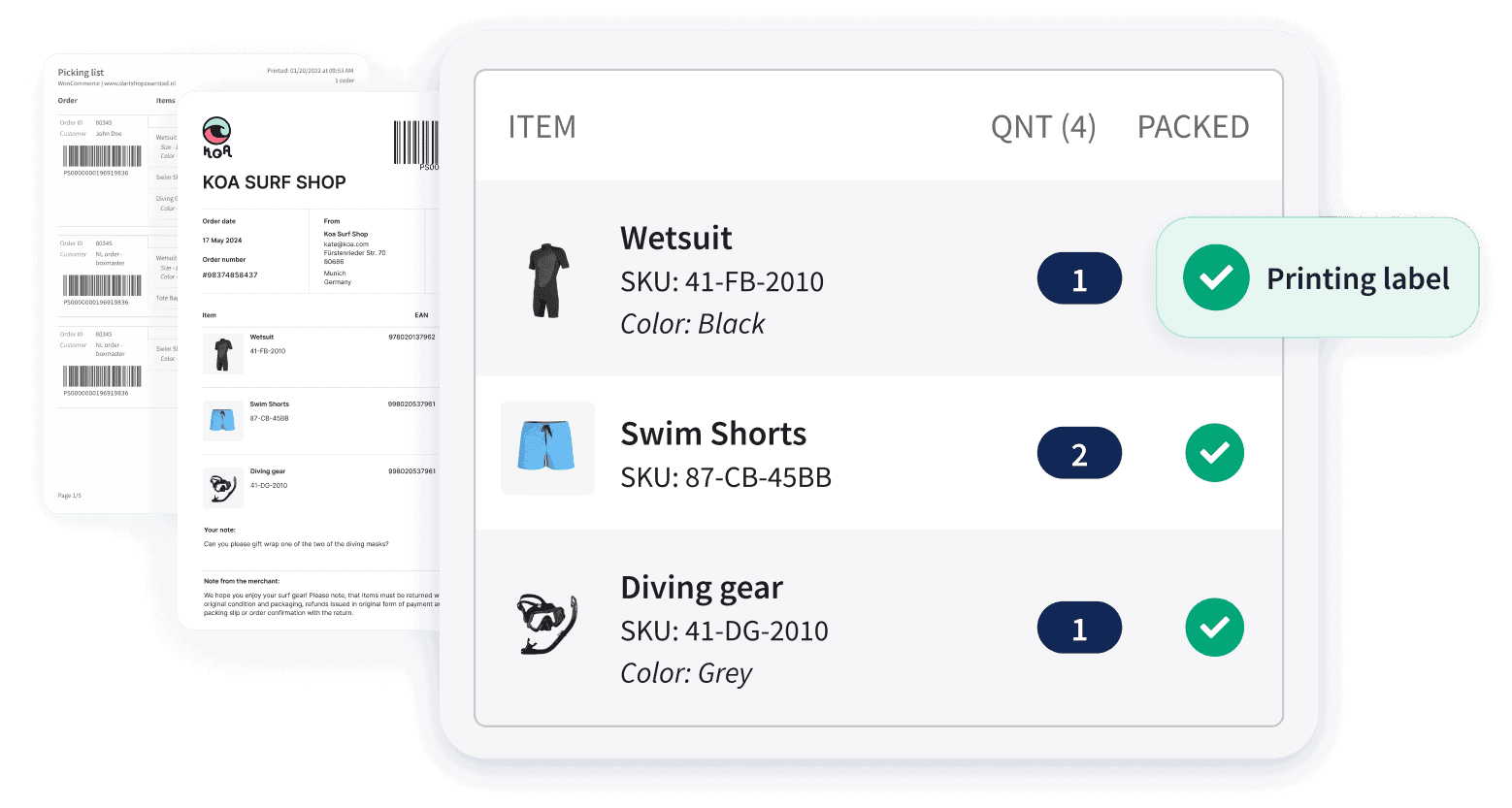
Creating shipping labels manually isn't advisable in any way, not even for new webshops. Any time you can spend on your webshop itself is worth it. With a shipping platform like Sendcloud, you turn orders into shipping labels in one click.
Want to work even faster? Then a label printer is the solution. By saving the label printer settings on your computer, you can print labels one after another in one go and stick them straight onto your parcel. A few rules for shipping labels:
Use at least 3 and at most 6 address lines. Do you have your customer's email address and phone number? Then include these details on the label to increase the chance of successful delivery.
Check for spelling mistakes.
Keep the address lines in the right order: 1. Name 2. Street name and house number 3. Postal code and city. Make sure to use spaces between the numbers and letters of the postal code and between the postal code and city.
International shipment? State the country name on the last line in English and in capital letters.
Don't use special formatting such as italic or underlined letters.
Always include the company name when you deliver to a business address.
7. Off to the carrier (or the carrier comes to you)
Once your parcel is “good to go” to be shipped, there's just one thing left. How do you get your parcel to the carrier? That depends on the shipping option you chose. With DHL Drop-off or bpost, you drop off your parcels at a service point yourself, and from there the parcel goes through the sorting centers with the right driver.
But there are also (free) pickup options, where the driver comes to you to collect the parcels. That's especially handy when you process a lot of parcels a day. Check with the carrier which shipping option lets you schedule pickups.
8. Shipping internationally?
Are you going to ship outside the EU? Then slightly different rules apply and you'll need additional documents, such as the customs declaration and a Commercial Invoice. You also need to be extra careful with your packaging.
According to international rules, your parcel must be able to withstand a drop of 1.5 meters. UPS has developed a handy tool that shows which rules apply per country. That way, you can be sure you meet the requirements, such as the documents you need to add to the shipment.
Correctly completed customs forms make sure your parcel is handled faster and arrives at your customer sooner. Do you have a Sendcloud account? Then you automatically print pre-filled customs forms.
Conclusion
We can say that your shipping strategy is all about making choices. Find out which carrier(s) suit your shipments and offer choices in your checkout. With the right shipping cost strategy and choices in your checkout, you can boost conversion.
When the orders start pouring in, the right packaging and shipping label let you ship your parcel without any problems. Always consider insurance when you ship high-value goods. You're responsible for shipping your parcel correctly. That's why we hope this webshop checklist helps you toward an optimal shipping strategy.
Want to read more about ecommerce logistics? Then read our article with all the options & benefits
How much time can you save on shipping?


Author and researcher
Iris Dings is a former Head of Content at Sendcloud with a focus on e-commerce, logistics, and content marketing for online retailers.
How much time can you save on shipping?

Share
Recommended for you

Shipping
Integrations
Best Shopify shipping apps: compare features, pricing & automation
Compare the best Shopify shipping apps for automation, carriers, labels, tracking, returns and international shipping. Find the right app for your store.

Shipping Intelligence
Shipping
E-commerce
Best 9 Shipping Data Analytics Software Tools (2026)
E-commerce
Enterprise