The Transmission API, minus the integration work
Add the Transmission API to your WMS, ERP, or marketplace through one Sendcloud integration. Ship B2B parcel and pallet across the Netherlands in fixed time slots, alongside 170+ other carriers.
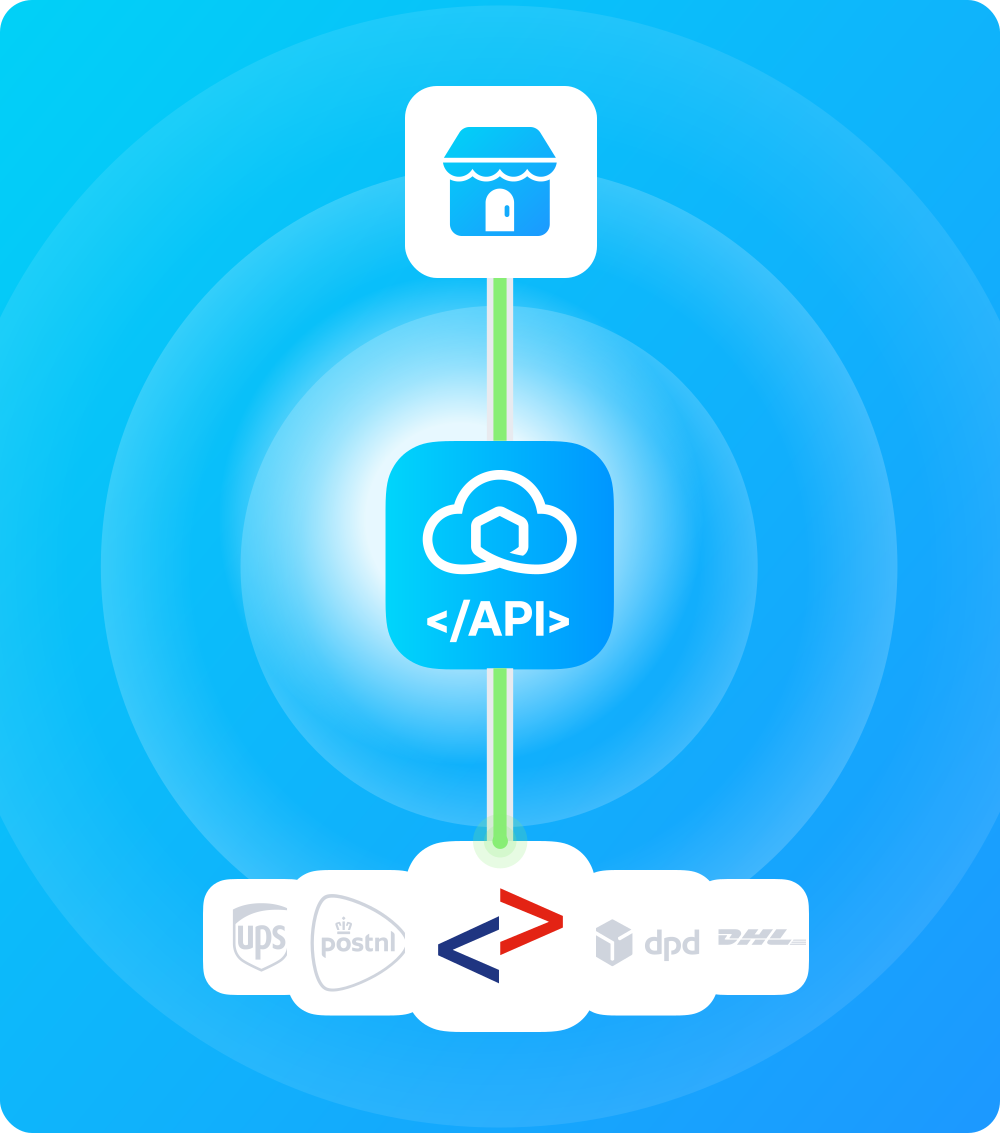
The Transmission API, minus the integration work
Add the Transmission API to your WMS, ERP, or marketplace through one Sendcloud integration. Ship B2B parcel and pallet across the Netherlands in fixed time slots, alongside 170+ other carriers.
The Transmission API, minus the integration work
Add the Transmission API to your WMS, ERP, or marketplace through one Sendcloud integration. Ship B2B parcel and pallet across the Netherlands in fixed time slots, alongside 170+ other carriers.
Free plan available
Works with your shop
Cancel anytime
Why integrate PostNL through the Sendcloud API?
Why integrate PostNL through the Sendcloud API?
Why integrate PostNL through the Sendcloud API?
Why integrate PostNL through the Sendcloud API?

Time-slot delivery for Dutch B2B
Ship under Sendcloud's negotiated PostNL rates from day one, or bring your own contract when you're ready.

Time slots: 8:00, 11:00, 12:00, 15:00
PostNL's evening windows and 4,500+ service points are available via Sendcloud's REST API, with no separate PostNL API credentials required.

Integrate with 170+ carriers at once
Stop maintaining and integrating different carrier and use one API for all.

GDPR Compliance
We comply with the GDPR rules to protect data and privacy in Europe.

API uptime of 99.99%
Reliable shipping software built on AWS and with top market technologies.

ISO 27001 Certified
The world’s most rigorous standards for information security.
Why integrate PostNL through the Sendcloud API?
Time-slot delivery for Dutch B2B
Ship under Sendcloud's negotiated PostNL rates from day one, or bring your own contract when you're ready.
Time slots: 8:00, 11:00, 12:00, 15:00
PostNL's evening windows and 4,500+ service points are available via Sendcloud's REST API, with no separate PostNL API credentials required.
Integrate with 170+ carriers at once
Stop maintaining and integrating different carrier and use one API for all.
GDPR Compliance
We comply with the GDPR rules to protect data and privacy in Europe.
API uptime of 99.99%
Reliable shipping software built on AWS and with top market technologies.
ISO 27001 Certified
The world’s most rigorous standards for information security.
Why integrate PostNL through the Sendcloud API?
Time-slot delivery for Dutch B2B
Ship under Sendcloud's negotiated PostNL rates from day one, or bring your own contract when you're ready.
Time slots: 8:00, 11:00, 12:00, 15:00
PostNL's evening windows and 4,500+ service points are available via Sendcloud's REST API, with no separate PostNL API credentials required.
Integrate with 170+ carriers at once
Stop maintaining and integrating different carrier and use one API for all.
GDPR Compliance
We comply with the GDPR rules to protect data and privacy in Europe.
API uptime of 99.99%
Reliable shipping software built on AWS and with top market technologies.
ISO 27001 Certified
The world’s most rigorous standards for information security.
The complete shipping API for any system
The complete shipping API for any system
The complete shipping API for any system
"Sendcloud allows us to connect to a lot of different carriers seamlessly."
Oscar Ziegler
Founder and CEO
-
Hive

"Sendcloud allows us to connect to a lot of different carriers seamlessly."
Oscar Ziegler
Founder and CEO
-
Hive
"Sendcloud allows us to connect to a lot of different carriers seamlessly."
Oscar Ziegler
Founder and CEO
-
Hive
API integration examples
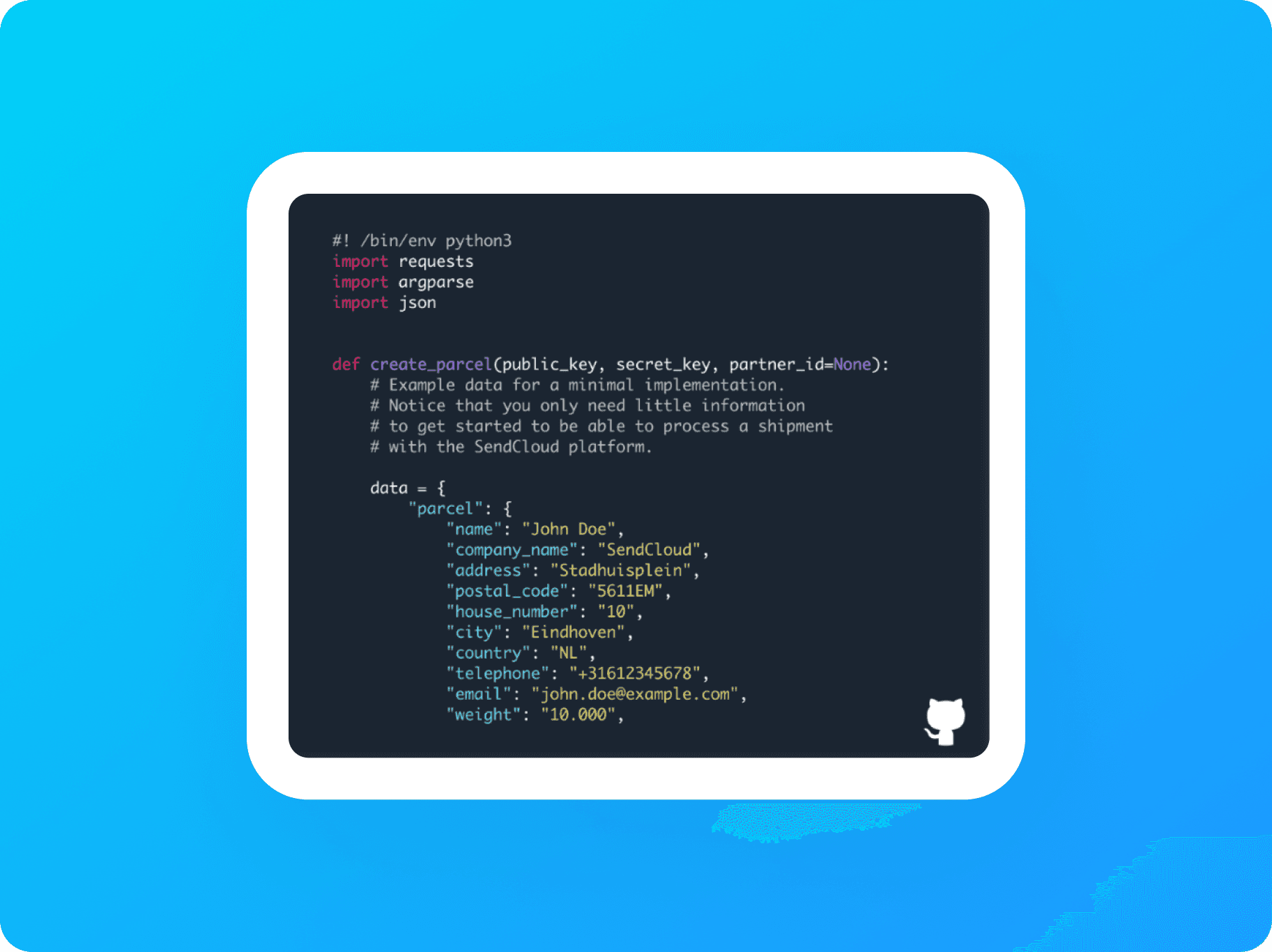
API Integration
See a basic example of an API integration using Python.
Service Point Picker
See how to integrate the Service Point Picker into a custom application.
API integration examples
API Integration
See a basic example of an API integration using Python.
Service Point Picker
See how to integrate the Service Point Picker into a custom application.
API integration examples
API Integration
See a basic example of an API integration using Python.
Service Point Picker
See how to integrate the Service Point Picker into a custom application.
Instantly connect to 170+ couriers Get started now
Free plan available
Works with your shop
Cancel anytime
More than 2,600 five star reviews


Instantly connect to 170+ couriers Get started now
Free plan available
Works with your shop
Cancel anytime
More than 2,600 five star reviews
Where do you start?
Where do you start?
Where do you start?



Questions & answers
Why integrate the Transmission API through Sendcloud instead of directly?
Direct Transmission integration means managing User, Password, Customer Number, Depot Number, and unit type per shipment, plus configuring time-specific delivery windows (8:00, 11:00, 12:00, 15:00) on every payload.
Through Sendcloud, you authenticate once with your Sendcloud API key and use a single REST schema for Transmission alongside every other carrier in your account. A direct Transmission contract is required either way; Sendcloud rates aren't offered for Transmission.
What happens when Transmission updates or breaks their API?
Transmission periodically updates time-specific service definitions and authentication. Direct integrators have to refresh credentials when changes affect authentication and re-test payloads when Transmission adjusts delivery windows.
When you ship Transmission through the Sendcloud REST API, the abstraction layer absorbs those changes. Sendcloud's engineering monitors Transmission's documentation and adjusts the carrier connector internally. Your Sendcloud request schema stays the same.
Can I use my own Transmission contract?
Yes, and you have to. Transmission requires a direct contract; Sendcloud rates aren't offered.
In Sendcloud, go to Shipping > Carriers > My Contracts, click Add your own contract, find Transmission, and click Add Contract. Enter User, Password, Customer Number, Depot Number, and Unit Type from your Transmission account manager.
If you ship using multiple unit types, add a separate Transmission contract for each. A Lite, Growth, or Premium plan is required. See the Transmission contract activation Help Center article.
Which Transmission products are supported through the API?
Through Sendcloud, you can ship Transmission's full Dutch product line, including time-specific delivery and personal handover:
Standard Transmission shipment
Time-specific delivery before 8:00, 11:00, 12:00, or 15:00
Time-window delivery (9:00-11:00, 10:00-12:00, 11:00-13:00, etc.)
Persoonlijk overhandigen: personal handoverLevering met legitimatieplicht: ID-verified deliveryBellen voor Aflevering: call before delivery
The Sendcloud shipping-methods endpoint returns the up-to-date list of methods enabled on your account.
Which Transmission-specific features does the API expose?
Transmission-specific features exposed through the integration:
Time-specific delivery slots: before 8:00, 11:00, 12:00, or 15:00
Time-window delivery (e.g. 9:00-11:00, 10:00-12:00, 11:00-13:00)
Personal handover (
Persoonlijk overhandigen) for high-value itemsID-verified delivery for sensitive shipments
Call-before-delivery option
Per-unit-type contracts: separate Sendcloud contract per packaging unit type
Tracking is automatically activated by Transmission once your contract is connected.
How do I track Transmission parcels?
Tracking is auto-activated by Transmission once your contract is connected. Time-specific delivery slot confirmation events (8:00, 11:00, 12:00, 15:00) appear alongside standard delivery events in the webhook stream.
All events normalise to Sendcloud's status taxonomy through GET https://panel.sendcloud.sc/api/v2/tracking/{tracking_number}, with the chronological history under statuses and each event mapped to parent_status. Subscribe to the parcel-status-changed webhook for push updates. Reference: Tracking parcels.
How do I create Transmission return labels?
Transmission return method availability depends on your contract setup. Time-specific return windows (8:00, 11:00, 12:00, 15:00) apply to returns where the contract supports them.
All return labels are created through Sendcloud's standalone v3 Returns API (synchronous or asynchronous; async is recommended for higher throughput). No outgoing parcel lookup or JWT tokens are required. Reference: Returns API overview.
How does Sendcloud's multi-carrier API compare to connecting carriers individually?
The Sendcloud REST API gives you access to 170+ carriers, including Transmission, through one credential set, one schema, one webhook stream, and one error model. Connecting carriers individually means handling separate authentication, payload formats, and tracking systems for each, and redoing the work every time a carrier ships breaking changes upstream.
With Sendcloud, you ship Transmission alongside PostNL, Bpost, DHL, and DPD, or any other carrier in your account using the same code. Route shipments between carriers based on rules (weight, destination, service level, cost) without writing carrier-specific routing logic. Fall back to alternative carriers automatically if Transmission's upstream system has issues.
Adding a new carrier later means adding it to your Sendcloud account, not building a new integration.
Questions & answers
Why integrate the Transmission API through Sendcloud instead of directly?
Direct Transmission integration means managing User, Password, Customer Number, Depot Number, and unit type per shipment, plus configuring time-specific delivery windows (8:00, 11:00, 12:00, 15:00) on every payload.
Through Sendcloud, you authenticate once with your Sendcloud API key and use a single REST schema for Transmission alongside every other carrier in your account. A direct Transmission contract is required either way; Sendcloud rates aren't offered for Transmission.
What happens when Transmission updates or breaks their API?
Transmission periodically updates time-specific service definitions and authentication. Direct integrators have to refresh credentials when changes affect authentication and re-test payloads when Transmission adjusts delivery windows.
When you ship Transmission through the Sendcloud REST API, the abstraction layer absorbs those changes. Sendcloud's engineering monitors Transmission's documentation and adjusts the carrier connector internally. Your Sendcloud request schema stays the same.
Can I use my own Transmission contract?
Yes, and you have to. Transmission requires a direct contract; Sendcloud rates aren't offered.
In Sendcloud, go to Shipping > Carriers > My Contracts, click Add your own contract, find Transmission, and click Add Contract. Enter User, Password, Customer Number, Depot Number, and Unit Type from your Transmission account manager.
If you ship using multiple unit types, add a separate Transmission contract for each. A Lite, Growth, or Premium plan is required. See the Transmission contract activation Help Center article.
Which Transmission products are supported through the API?
Through Sendcloud, you can ship Transmission's full Dutch product line, including time-specific delivery and personal handover:
Standard Transmission shipment
Time-specific delivery before 8:00, 11:00, 12:00, or 15:00
Time-window delivery (9:00-11:00, 10:00-12:00, 11:00-13:00, etc.)
Persoonlijk overhandigen: personal handoverLevering met legitimatieplicht: ID-verified deliveryBellen voor Aflevering: call before delivery
The Sendcloud shipping-methods endpoint returns the up-to-date list of methods enabled on your account.
Which Transmission-specific features does the API expose?
Transmission-specific features exposed through the integration:
Time-specific delivery slots: before 8:00, 11:00, 12:00, or 15:00
Time-window delivery (e.g. 9:00-11:00, 10:00-12:00, 11:00-13:00)
Personal handover (
Persoonlijk overhandigen) for high-value itemsID-verified delivery for sensitive shipments
Call-before-delivery option
Per-unit-type contracts: separate Sendcloud contract per packaging unit type
Tracking is automatically activated by Transmission once your contract is connected.
How do I track Transmission parcels?
Tracking is auto-activated by Transmission once your contract is connected. Time-specific delivery slot confirmation events (8:00, 11:00, 12:00, 15:00) appear alongside standard delivery events in the webhook stream.
All events normalise to Sendcloud's status taxonomy through GET https://panel.sendcloud.sc/api/v2/tracking/{tracking_number}, with the chronological history under statuses and each event mapped to parent_status. Subscribe to the parcel-status-changed webhook for push updates. Reference: Tracking parcels.
How do I create Transmission return labels?
Transmission return method availability depends on your contract setup. Time-specific return windows (8:00, 11:00, 12:00, 15:00) apply to returns where the contract supports them.
All return labels are created through Sendcloud's standalone v3 Returns API (synchronous or asynchronous; async is recommended for higher throughput). No outgoing parcel lookup or JWT tokens are required. Reference: Returns API overview.
How does Sendcloud's multi-carrier API compare to connecting carriers individually?
The Sendcloud REST API gives you access to 170+ carriers, including Transmission, through one credential set, one schema, one webhook stream, and one error model. Connecting carriers individually means handling separate authentication, payload formats, and tracking systems for each, and redoing the work every time a carrier ships breaking changes upstream.
With Sendcloud, you ship Transmission alongside PostNL, Bpost, DHL, and DPD, or any other carrier in your account using the same code. Route shipments between carriers based on rules (weight, destination, service level, cost) without writing carrier-specific routing logic. Fall back to alternative carriers automatically if Transmission's upstream system has issues.
Adding a new carrier later means adding it to your Sendcloud account, not building a new integration.
Questions & answers
Why integrate the Transmission API through Sendcloud instead of directly?
Direct Transmission integration means managing User, Password, Customer Number, Depot Number, and unit type per shipment, plus configuring time-specific delivery windows (8:00, 11:00, 12:00, 15:00) on every payload.
Through Sendcloud, you authenticate once with your Sendcloud API key and use a single REST schema for Transmission alongside every other carrier in your account. A direct Transmission contract is required either way; Sendcloud rates aren't offered for Transmission.
What happens when Transmission updates or breaks their API?
Transmission periodically updates time-specific service definitions and authentication. Direct integrators have to refresh credentials when changes affect authentication and re-test payloads when Transmission adjusts delivery windows.
When you ship Transmission through the Sendcloud REST API, the abstraction layer absorbs those changes. Sendcloud's engineering monitors Transmission's documentation and adjusts the carrier connector internally. Your Sendcloud request schema stays the same.
Can I use my own Transmission contract?
Yes, and you have to. Transmission requires a direct contract; Sendcloud rates aren't offered.
In Sendcloud, go to Shipping > Carriers > My Contracts, click Add your own contract, find Transmission, and click Add Contract. Enter User, Password, Customer Number, Depot Number, and Unit Type from your Transmission account manager.
If you ship using multiple unit types, add a separate Transmission contract for each. A Lite, Growth, or Premium plan is required. See the Transmission contract activation Help Center article.
Which Transmission products are supported through the API?
Through Sendcloud, you can ship Transmission's full Dutch product line, including time-specific delivery and personal handover:
Standard Transmission shipment
Time-specific delivery before 8:00, 11:00, 12:00, or 15:00
Time-window delivery (9:00-11:00, 10:00-12:00, 11:00-13:00, etc.)
Persoonlijk overhandigen: personal handoverLevering met legitimatieplicht: ID-verified deliveryBellen voor Aflevering: call before delivery
The Sendcloud shipping-methods endpoint returns the up-to-date list of methods enabled on your account.
Which Transmission-specific features does the API expose?
Transmission-specific features exposed through the integration:
Time-specific delivery slots: before 8:00, 11:00, 12:00, or 15:00
Time-window delivery (e.g. 9:00-11:00, 10:00-12:00, 11:00-13:00)
Personal handover (
Persoonlijk overhandigen) for high-value itemsID-verified delivery for sensitive shipments
Call-before-delivery option
Per-unit-type contracts: separate Sendcloud contract per packaging unit type
Tracking is automatically activated by Transmission once your contract is connected.
How do I track Transmission parcels?
Tracking is auto-activated by Transmission once your contract is connected. Time-specific delivery slot confirmation events (8:00, 11:00, 12:00, 15:00) appear alongside standard delivery events in the webhook stream.
All events normalise to Sendcloud's status taxonomy through GET https://panel.sendcloud.sc/api/v2/tracking/{tracking_number}, with the chronological history under statuses and each event mapped to parent_status. Subscribe to the parcel-status-changed webhook for push updates. Reference: Tracking parcels.
How do I create Transmission return labels?
Transmission return method availability depends on your contract setup. Time-specific return windows (8:00, 11:00, 12:00, 15:00) apply to returns where the contract supports them.
All return labels are created through Sendcloud's standalone v3 Returns API (synchronous or asynchronous; async is recommended for higher throughput). No outgoing parcel lookup or JWT tokens are required. Reference: Returns API overview.
How does Sendcloud's multi-carrier API compare to connecting carriers individually?
The Sendcloud REST API gives you access to 170+ carriers, including Transmission, through one credential set, one schema, one webhook stream, and one error model. Connecting carriers individually means handling separate authentication, payload formats, and tracking systems for each, and redoing the work every time a carrier ships breaking changes upstream.
With Sendcloud, you ship Transmission alongside PostNL, Bpost, DHL, and DPD, or any other carrier in your account using the same code. Route shipments between carriers based on rules (weight, destination, service level, cost) without writing carrier-specific routing logic. Fall back to alternative carriers automatically if Transmission's upstream system has issues.
Adding a new carrier later means adding it to your Sendcloud account, not building a new integration.
One API for all your shipping needs
No setup fees
Same-day integration
Ship with Europe’s top carriers
One API for all your shipping needs
No setup fees
Same-day integration
Ship with Europe’s top carriers
One API for all your shipping needs
No setup fees
Same-day integration
Ship with Europe’s top carriers
Product
Solutions
Integrations
© 2026 Sendcloud. All Rights Reserved
Chamber of Commerce: 66572959
VAT number: NL856613897B01
Product
Integrations
Solutions
Resources
© 2026 Sendcloud. All Rights Reserved
Chamber of Commerce: 66572959
VAT number: NL856613897B01
Product
© 2026 Sendcloud. All Rights Reserved
Chamber of Commerce: 66572959
VAT number: NL856613897B01