The easiest way to integrate with the InPost API
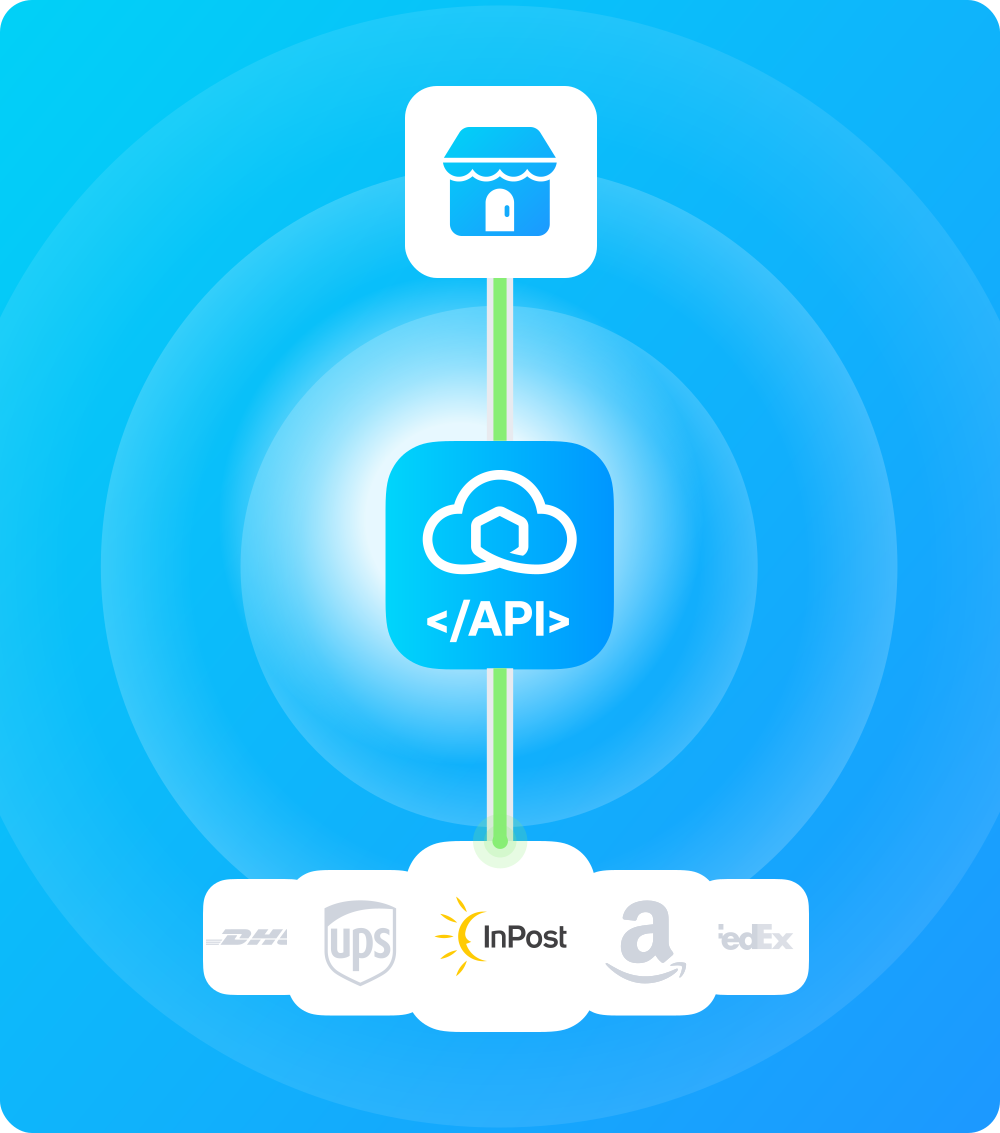
One Sendcloud integration connects your WMS, marketplace, or 3PL stack to the InPost API and 170+ other carriers. Ship to parcel lockers across five European markets, without a separate InPost integration to build.
The easiest way to integrate with the InPost API
One Sendcloud integration connects your WMS, marketplace, or 3PL stack to the InPost API and 170+ other carriers. Ship to parcel lockers across five European markets, without a separate InPost integration to build.
The easiest way to integrate with the InPost API
One Sendcloud integration connects your WMS, marketplace, or 3PL stack to the InPost API and 170+ other carriers. Ship to parcel lockers across five European markets, without a separate InPost integration to build.
Thoroughly documented
Tested on millions of shipments
Available on all plans
Why integrate InPost through the Sendcloud API?

Europe's leading parcel locker carrier
InPost is the leading parcel locker operator in Poland and is expanding across Western Europe. Sendcloud returns locker IDs per market and handles label format differences between countries automatically.

Three locker delivery flows
Locker 2 Locker, Address to Locker, and Instant Returns are all available through Sendcloud's REST API. Instant Returns lets shoppers drop off at any locker without a printed label.

Integrate with 170+ carriers at once
Stop maintaining and integrating different carrier and use one API for all.

GDPR Compliance
We comply with the GDPR rules to protect data and privacy in Europe.

API uptime of 99.99%
Reliable shipping software built on AWS and with top market technologies.

ISO 27001 Certified
The world’s most rigorous standards for information security.
Why integrate InPost through the Sendcloud API?
Europe's leading parcel locker carrier
InPost is the leading parcel locker operator in Poland and is expanding across Western Europe. Sendcloud returns locker IDs per market and handles label format differences between countries automatically.
Three locker delivery flows
Locker 2 Locker, Address to Locker, and Instant Returns are all available through Sendcloud's REST API. Instant Returns lets shoppers drop off at any locker without a printed label.
Integrate with 170+ carriers at once
Stop maintaining and integrating different carrier and use one API for all.
GDPR Compliance
We comply with the GDPR rules to protect data and privacy in Europe.
API uptime of 99.99%
Reliable shipping software built on AWS and with top market technologies.
ISO 27001 Certified
The world’s most rigorous standards for information security.
Why integrate InPost through the Sendcloud API?
Europe's leading parcel locker carrier
InPost is the leading parcel locker operator in Poland and is expanding across Western Europe. Sendcloud returns locker IDs per market and handles label format differences between countries automatically.
Three locker delivery flows
Locker 2 Locker, Address to Locker, and Instant Returns are all available through Sendcloud's REST API. Instant Returns lets shoppers drop off at any locker without a printed label.
Integrate with 170+ carriers at once
Stop maintaining and integrating different carrier and use one API for all.
GDPR Compliance
We comply with the GDPR rules to protect data and privacy in Europe.
API uptime of 99.99%
Reliable shipping software built on AWS and with top market technologies.
ISO 27001 Certified
The world’s most rigorous standards for information security.
The complete shipping API for any system
The complete shipping API for any system
The complete shipping API for any system
"Sendcloud allows us to connect to a lot of different carriers seamlessly."
Oscar Ziegler
Founder and CEO
-
Hive

"Sendcloud allows us to connect to a lot of different carriers seamlessly."
Oscar Ziegler
Founder and CEO
-
Hive
"Sendcloud allows us to connect to a lot of different carriers seamlessly."
Oscar Ziegler
Founder and CEO
-
Hive
API integration examples
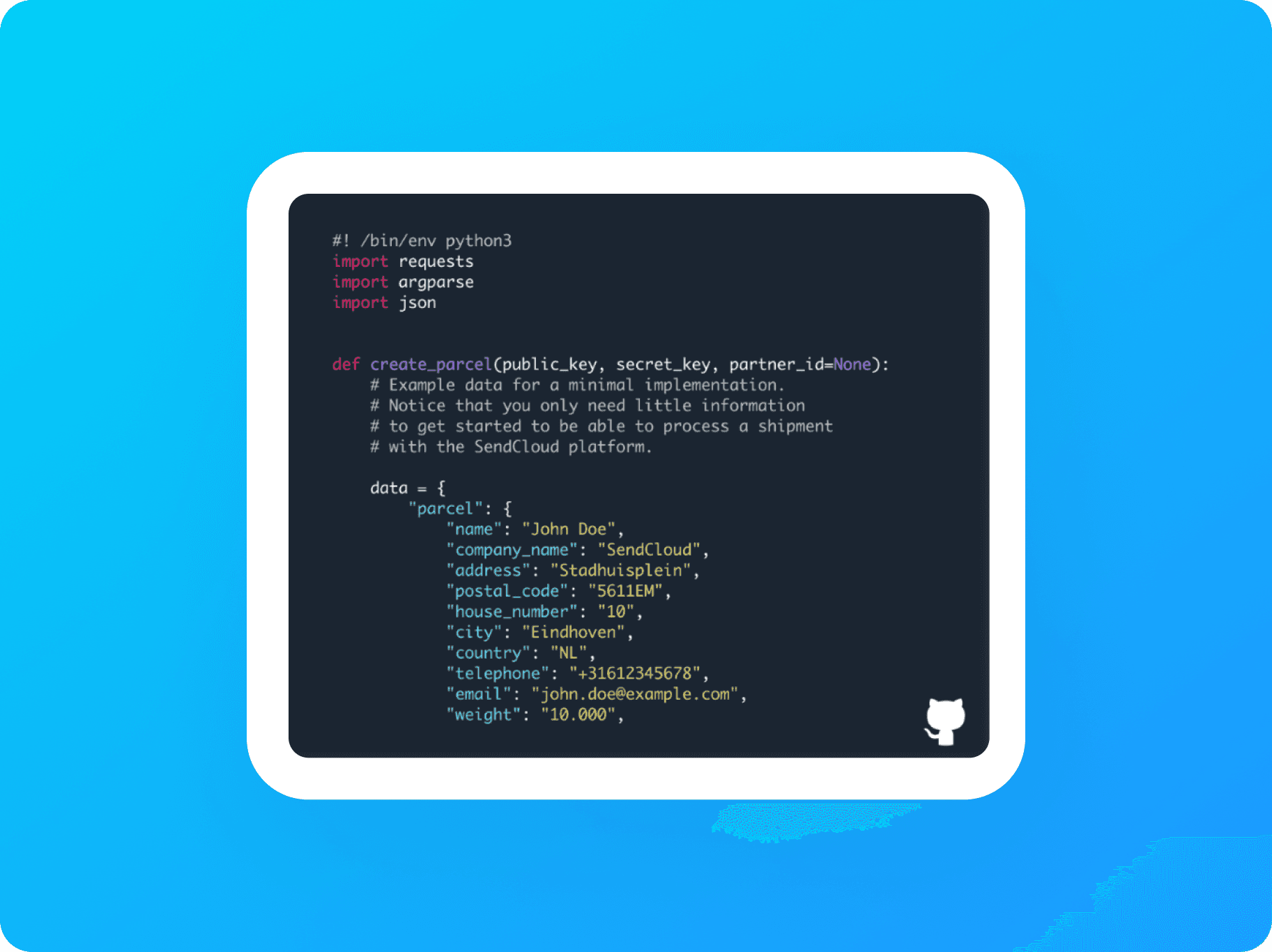
API Integration
See a basic example of an API integration using Python.
Service Point Picker
See how to integrate the Service Point Picker into a custom application.
API integration examples
API Integration
See a basic example of an API integration using Python.
Service Point Picker
See how to integrate the Service Point Picker into a custom application.
API integration examples
API Integration
See a basic example of an API integration using Python.
Service Point Picker
See how to integrate the Service Point Picker into a custom application.



Where do you start?
Where do you start?
Where do you start?


One API for all your shipping needs
No setup fees
Same-day integration
Ship with Europe's top carriers
Questions & answers
Why integrate the InPost API through Sendcloud instead of directly?
Direct InPost integration means managing separate APIs and credentials for each market: InPost UK, InPost Italy, InPost ES, and InPost Global. Each market has different fields (Client ID + API Token for UK, Organization ID + Bearer Token + Brand ID + LoginAPI + API Key for Italy, Username + Password + Dual Carrier API credentials for Spain). For UK, every locker service needs its own credentials.
Through Sendcloud, you authenticate once with your Sendcloud API key and use a single REST schema for InPost alongside every other carrier. A direct InPost contract is required either way; Sendcloud rates aren't offered for InPost.
What happens when InPost updates or breaks their API?
InPost runs separate APIs per market and updates them independently. Direct integrators have to track changes across InPost UK, Italy, Spain, and Global, refresh credentials when authentication updates, and adjust per-service routing logic when locker product codes change.
When you ship InPost through the Sendcloud REST API, the abstraction layer absorbs those changes. Sendcloud's engineering tracks each InPost market and updates the connectors internally. Your Sendcloud request schema stays the same whether you ship Locker 2 Locker, Address to Locker, or Instant Returns.
Can I use my own InPost contract?
Yes, and you have to. InPost requires direct contracts; Sendcloud rates aren't offered. Each InPost market is a separate contract setup.
In Sendcloud, go to Shipping > Carriers, find the InPost variant you need (InPost UK, InPost Italy, InPost ES, or InPost Global), click Enable, and add your contract under My Contracts. For InPost UK, you also need separate credentials for each service (Locker 2 Locker, Locker to Address, etc.). Locker to Address and Locker to Address Returns share credentials.
See the InPost UK contract activation Help Center article, the InPost Italy article, or the InPost ES article.
Which InPost products are supported through the API?
Through Sendcloud, you can ship InPost's full locker network:
InPost Locker 2 LockerandLocker 2 Locker ReturnsInPost Locker to AddressandLocker to Address ReturnsInPost Address to LockerInPost ReturnsandInPost Instant ReturnsInPost Italy: international Locker shipments and domestic Home Delivery (via InPost Global)
InPost Spain: Dual Carrier API services for Relay-to-Relay and pickup variants
The Sendcloud shipping-methods endpoint returns the up-to-date list of methods enabled on your contract.
Which InPost-specific features does the API expose?
InPost-specific locker features exposed through the integration:
Locker-to-locker shipping: parcels move between InPost lockers without ever needing a home address
Address-to-locker and locker-to-address routing for hybrid flows
Instant Returnsfor low-friction return drop-off at any InPost lockerPer-market locker network access (UK, Spain, Italy, Poland, NL)
InPost Italy: international Locker shipments cross-border
InPost Spain: pickup option (you/are using a pick-up checkbox) for Relay-to-Relay variants
Each market's locker network has its own coverage and density; check the InPost site for current locker availability per region.
How do I track InPost parcels?
InPost tracking surfaces locker drop-off, in-transit, and locker-arrival events. Each event appears with the locker location in the payload, so you can stream locker-readiness updates directly to your customer.
All events normalise to Sendcloud's status taxonomy through GET https://panel.sendcloud.sc/api/v2/tracking/{tracking_number}, with the chronological history under statuses and each event mapped to parent_status. Subscribe to the parcel-status-changed webhook for push updates. Reference: Tracking parcels.
How do I create InPost return labels?
Returns are core to InPost. Four dedicated services cover the locker network: Locker 2 Locker Returns, Locker to Address Returns, InPost Returns, and Instant Returns. All four use the same Sendcloud return endpoints as every other carrier.
All return labels are created through Sendcloud's standalone v3 Returns API (synchronous or asynchronous; async is recommended for higher throughput). No outgoing parcel lookup or JWT tokens are required. Reference: Returns API overview.
How does Sendcloud's multi-carrier API compare to connecting carriers individually?
The Sendcloud REST API gives you access to 170+ carriers, including InPost, through one credential set, one schema, one webhook stream, and one error model. Connecting carriers individually means handling separate authentication, payload formats, and tracking systems for each, and redoing the work every time a carrier ships breaking changes upstream.
With Sendcloud, you ship InPost alongside DHL, DPD, Royal Mail, and Evri, or any other carrier in your account using the same code. Route shipments between carriers based on rules (weight, destination, service level, cost) without writing carrier-specific routing logic. Fall back to alternative carriers automatically if InPost's upstream system has issues.
Adding a new carrier later means adding it to your Sendcloud account, not building a new integration.
Questions & answers
Why integrate the InPost API through Sendcloud instead of directly?
Direct InPost integration means managing separate APIs and credentials for each market: InPost UK, InPost Italy, InPost ES, and InPost Global. Each market has different fields (Client ID + API Token for UK, Organization ID + Bearer Token + Brand ID + LoginAPI + API Key for Italy, Username + Password + Dual Carrier API credentials for Spain). For UK, every locker service needs its own credentials.
Through Sendcloud, you authenticate once with your Sendcloud API key and use a single REST schema for InPost alongside every other carrier. A direct InPost contract is required either way; Sendcloud rates aren't offered for InPost.
What happens when InPost updates or breaks their API?
InPost runs separate APIs per market and updates them independently. Direct integrators have to track changes across InPost UK, Italy, Spain, and Global, refresh credentials when authentication updates, and adjust per-service routing logic when locker product codes change.
When you ship InPost through the Sendcloud REST API, the abstraction layer absorbs those changes. Sendcloud's engineering tracks each InPost market and updates the connectors internally. Your Sendcloud request schema stays the same whether you ship Locker 2 Locker, Address to Locker, or Instant Returns.
Can I use my own InPost contract?
Yes, and you have to. InPost requires direct contracts; Sendcloud rates aren't offered. Each InPost market is a separate contract setup.
In Sendcloud, go to Shipping > Carriers, find the InPost variant you need (InPost UK, InPost Italy, InPost ES, or InPost Global), click Enable, and add your contract under My Contracts. For InPost UK, you also need separate credentials for each service (Locker 2 Locker, Locker to Address, etc.). Locker to Address and Locker to Address Returns share credentials.
See the InPost UK contract activation Help Center article, the InPost Italy article, or the InPost ES article.
Which InPost products are supported through the API?
Through Sendcloud, you can ship InPost's full locker network:
InPost Locker 2 LockerandLocker 2 Locker ReturnsInPost Locker to AddressandLocker to Address ReturnsInPost Address to LockerInPost ReturnsandInPost Instant ReturnsInPost Italy: international Locker shipments and domestic Home Delivery (via InPost Global)
InPost Spain: Dual Carrier API services for Relay-to-Relay and pickup variants
The Sendcloud shipping-methods endpoint returns the up-to-date list of methods enabled on your contract.
Which InPost-specific features does the API expose?
InPost-specific locker features exposed through the integration:
Locker-to-locker shipping: parcels move between InPost lockers without ever needing a home address
Address-to-locker and locker-to-address routing for hybrid flows
Instant Returnsfor low-friction return drop-off at any InPost lockerPer-market locker network access (UK, Spain, Italy, Poland, NL)
InPost Italy: international Locker shipments cross-border
InPost Spain: pickup option (you/are using a pick-up checkbox) for Relay-to-Relay variants
Each market's locker network has its own coverage and density; check the InPost site for current locker availability per region.
How do I track InPost parcels?
InPost tracking surfaces locker drop-off, in-transit, and locker-arrival events. Each event appears with the locker location in the payload, so you can stream locker-readiness updates directly to your customer.
All events normalise to Sendcloud's status taxonomy through GET https://panel.sendcloud.sc/api/v2/tracking/{tracking_number}, with the chronological history under statuses and each event mapped to parent_status. Subscribe to the parcel-status-changed webhook for push updates. Reference: Tracking parcels.
How do I create InPost return labels?
Returns are core to InPost. Four dedicated services cover the locker network: Locker 2 Locker Returns, Locker to Address Returns, InPost Returns, and Instant Returns. All four use the same Sendcloud return endpoints as every other carrier.
All return labels are created through Sendcloud's standalone v3 Returns API (synchronous or asynchronous; async is recommended for higher throughput). No outgoing parcel lookup or JWT tokens are required. Reference: Returns API overview.
How does Sendcloud's multi-carrier API compare to connecting carriers individually?
The Sendcloud REST API gives you access to 170+ carriers, including InPost, through one credential set, one schema, one webhook stream, and one error model. Connecting carriers individually means handling separate authentication, payload formats, and tracking systems for each, and redoing the work every time a carrier ships breaking changes upstream.
With Sendcloud, you ship InPost alongside DHL, DPD, Royal Mail, and Evri, or any other carrier in your account using the same code. Route shipments between carriers based on rules (weight, destination, service level, cost) without writing carrier-specific routing logic. Fall back to alternative carriers automatically if InPost's upstream system has issues.
Adding a new carrier later means adding it to your Sendcloud account, not building a new integration.
Questions & answers
Why integrate the InPost API through Sendcloud instead of directly?
Direct InPost integration means managing separate APIs and credentials for each market: InPost UK, InPost Italy, InPost ES, and InPost Global. Each market has different fields (Client ID + API Token for UK, Organization ID + Bearer Token + Brand ID + LoginAPI + API Key for Italy, Username + Password + Dual Carrier API credentials for Spain). For UK, every locker service needs its own credentials.
Through Sendcloud, you authenticate once with your Sendcloud API key and use a single REST schema for InPost alongside every other carrier. A direct InPost contract is required either way; Sendcloud rates aren't offered for InPost.
What happens when InPost updates or breaks their API?
InPost runs separate APIs per market and updates them independently. Direct integrators have to track changes across InPost UK, Italy, Spain, and Global, refresh credentials when authentication updates, and adjust per-service routing logic when locker product codes change.
When you ship InPost through the Sendcloud REST API, the abstraction layer absorbs those changes. Sendcloud's engineering tracks each InPost market and updates the connectors internally. Your Sendcloud request schema stays the same whether you ship Locker 2 Locker, Address to Locker, or Instant Returns.
Can I use my own InPost contract?
Yes, and you have to. InPost requires direct contracts; Sendcloud rates aren't offered. Each InPost market is a separate contract setup.
In Sendcloud, go to Shipping > Carriers, find the InPost variant you need (InPost UK, InPost Italy, InPost ES, or InPost Global), click Enable, and add your contract under My Contracts. For InPost UK, you also need separate credentials for each service (Locker 2 Locker, Locker to Address, etc.). Locker to Address and Locker to Address Returns share credentials.
See the InPost UK contract activation Help Center article, the InPost Italy article, or the InPost ES article.
Which InPost products are supported through the API?
Through Sendcloud, you can ship InPost's full locker network:
InPost Locker 2 LockerandLocker 2 Locker ReturnsInPost Locker to AddressandLocker to Address ReturnsInPost Address to LockerInPost ReturnsandInPost Instant ReturnsInPost Italy: international Locker shipments and domestic Home Delivery (via InPost Global)
InPost Spain: Dual Carrier API services for Relay-to-Relay and pickup variants
The Sendcloud shipping-methods endpoint returns the up-to-date list of methods enabled on your contract.
Which InPost-specific features does the API expose?
InPost-specific locker features exposed through the integration:
Locker-to-locker shipping: parcels move between InPost lockers without ever needing a home address
Address-to-locker and locker-to-address routing for hybrid flows
Instant Returnsfor low-friction return drop-off at any InPost lockerPer-market locker network access (UK, Spain, Italy, Poland, NL)
InPost Italy: international Locker shipments cross-border
InPost Spain: pickup option (you/are using a pick-up checkbox) for Relay-to-Relay variants
Each market's locker network has its own coverage and density; check the InPost site for current locker availability per region.
How do I track InPost parcels?
InPost tracking surfaces locker drop-off, in-transit, and locker-arrival events. Each event appears with the locker location in the payload, so you can stream locker-readiness updates directly to your customer.
All events normalise to Sendcloud's status taxonomy through GET https://panel.sendcloud.sc/api/v2/tracking/{tracking_number}, with the chronological history under statuses and each event mapped to parent_status. Subscribe to the parcel-status-changed webhook for push updates. Reference: Tracking parcels.
How do I create InPost return labels?
Returns are core to InPost. Four dedicated services cover the locker network: Locker 2 Locker Returns, Locker to Address Returns, InPost Returns, and Instant Returns. All four use the same Sendcloud return endpoints as every other carrier.
All return labels are created through Sendcloud's standalone v3 Returns API (synchronous or asynchronous; async is recommended for higher throughput). No outgoing parcel lookup or JWT tokens are required. Reference: Returns API overview.
How does Sendcloud's multi-carrier API compare to connecting carriers individually?
The Sendcloud REST API gives you access to 170+ carriers, including InPost, through one credential set, one schema, one webhook stream, and one error model. Connecting carriers individually means handling separate authentication, payload formats, and tracking systems for each, and redoing the work every time a carrier ships breaking changes upstream.
With Sendcloud, you ship InPost alongside DHL, DPD, Royal Mail, and Evri, or any other carrier in your account using the same code. Route shipments between carriers based on rules (weight, destination, service level, cost) without writing carrier-specific routing logic. Fall back to alternative carriers automatically if InPost's upstream system has issues.
Adding a new carrier later means adding it to your Sendcloud account, not building a new integration.
Product
Solutions
Integrations
© 2026 Sendcloud. All Rights Reserved
Chamber of Commerce: 66572959
VAT number: NL856613897B01
Product
Integrations
Solutions
Resources
© 2026 Sendcloud. All Rights Reserved
Chamber of Commerce: 66572959
VAT number: NL856613897B01
Product
© 2026 Sendcloud. All Rights Reserved
Chamber of Commerce: 66572959
VAT number: NL856613897B01